Why Atomic Habits Works Better When You Lead Yourself First
Mar 04, 2026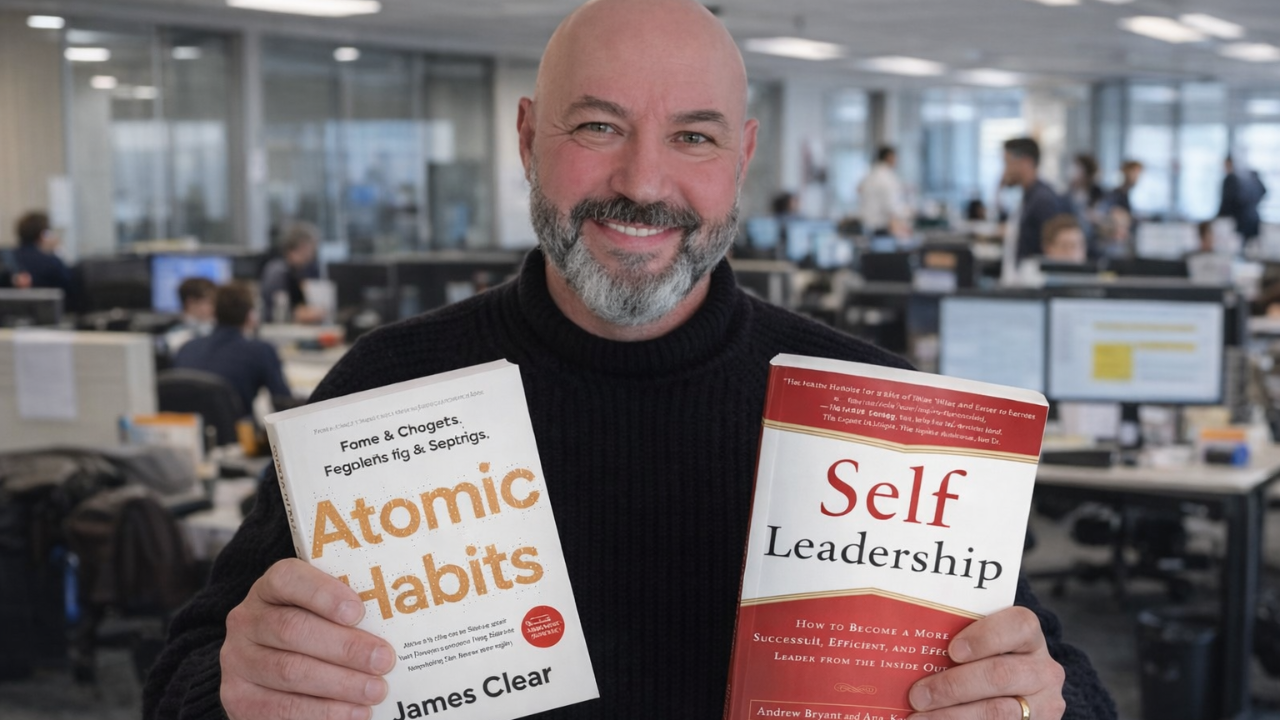
Last updated: August 18, 2026
James Clear's Atomic Habits has sold over 15 million copies. It is one of the most practical books ever written about behaviour change. If you haven't read it, the core idea is deceptively simple: small improvements of 1% compound over time into remarkable results.
And yet, thousands of people read Atomic Habits, faithfully apply the system, and still feel vaguely unfulfilled. The habits stick. The results arrive. But something feels off.
Here is why: habits are a vehicle. Before you optimise the vehicle, you need to know where you're going.
That is where self-leadership comes in.
The Question Atomic Habits Doesn't Ask
James Clear is brilliant on the mechanics of change. His Four Laws of Behaviour Change (make it obvious, make it attractive, make it easy, make it satisfying) are among the most actionable frameworks in personal development literature.
But there is a question that precedes all of them: who are you choosing to become, and why?
Self-leadership is the practice of intentionally influencing your thinking, feeling, and actions toward your objectives. It is not a technique. It is a philosophy of human agency that begins where most self-help books end: with the deliberate, conscious choice to take responsibility for your own direction.
Without self-leadership, you can become very efficient at climbing the wrong ladder.
Where Atomic Habits Gets Identity Right
To his credit, Clear does touch on identity. In fact, one of his most quoted insights is that lasting change is identity-based: you don't just want to run a marathon, you see yourself as a runner. You don't just want to write; you see yourself as a writer.
This is where his thinking and self-leadership genuinely converge.
Self-leadership also begins with identity, specifically with what I call intentional self-definition: the conscious choice to decide who you are, what you stand for, and what kind of leader you intend to be. Both frameworks agree that behaviour follows belief. If you change what you do without changing how you see yourself, the change rarely lasts.
The difference is one of depth. For Clear, identity is a tool in service of better habits. For self-leadership practitioners, identity is the foundation on which everything else is built, including habits, relationships, decisions, and the way you show up under pressure.
Two Frameworks, Two Altitudes
Think of it this way. Self-leadership operates at the strategic level. Atomic Habits operates at the tactical level. You need both, but in the right order.
Self-leadership answers:
- Who am I, and who do I choose to become?
- What do I value, and am I living in alignment with those values?
- Where am I leading myself and others, and why does it matter?
- How do I manage my inner world so I can perform effectively in the outer world?
Atomic Habits answers:
- How do I make the right behaviours easier to repeat?
- How do I design my environment to support consistent action?
- How do I build and break habits more reliably?
- How do I track progress and sustain momentum?
The self-leadership questions come first. Once you have answered them, the habit-building tools become far more powerful because they are in service of something meaningful.
The IGNITE Framework: A Self-Leadership Map for Sustainable Change

In my work with leaders across six continents and in my latest book, POTENTIAL-IZE: How Leaders Unlock Human Potential in the Age of AI (Wiley, 2026), I introduce the IGNITE Framework as a structured path to self-leadership development.
IGNITE moves a leader through six stages: Inspire, Guide, Nurture, Integrate, Transform, and Evaluate.
You begin by finding what truly Inspires you, the deeper purpose that makes sustained effort worthwhile. You then Guide that energy with clarity and intention, setting meaningful direction rather than just goals. You Nurture the inner conditions for growth: mindset, emotional regulation, and physical wellbeing. You Integrate new behaviours and beliefs into your identity, making them part of who you are rather than things you are trying to do. You Transform your leadership presence and impact, expanding your influence on others. And finally, you Evaluate your progress honestly, using reflection to course-correct and deepen self-awareness.
Notice that Evaluate, the stage most closely aligned with Clear's habit-tracking and feedback loops, comes last. Not because it is least important, but because measurement is most meaningful when it is anchored in something that genuinely matters to you.
A leader who reaches the Evaluate stage with clear inspiration, purposeful guidance, nurtured resilience, integrated identity, and real transformation is not just tracking habits. They are measuring momentum toward a life and career they have consciously designed.
That is where Atomic Habits becomes extraordinary. The Four Laws, applied at this stage, become the operational engine of a self-directed life.
A Practical Integration: How to Use Both Frameworks Together
You do not need to choose between Clear and self-leadership. Here is how to use both:
Step 1: Start with Self-Leadership
Before you open your habit tracker, spend time with the foundational questions of self-leadership. What does success mean to you, specifically? What values must any meaningful habit serve? What kind of leader do you want to be in five years? What is the gap between who you are today and who you intend to become?
This is not soft thinking. This is strategic clarity. Without it, you are optimising without a destination.
Step 2: Define Your Identity-Based Vision
Both frameworks agree: identity drives behaviour. Write down the leader you are becoming. Not the habits you want to build, but the person whose natural behaviour those habits reflect. "I am someone who prioritises deep thinking before reacting." "I am a leader who invests in others' growth." Make it specific, personal, and aligned with your values.
Step 3: Apply the Four Laws with Purpose
Now apply Clear's Four Laws in the context of your self-leadership vision. Make the habit obvious by connecting it visually to your stated intention. Make it attractive by linking it to your identity statement. Make it easy through environmental design. Make it satisfying by tracking it against a meaningful goal, not just a streak.
Step 4: Use Reflection as a Habit in Itself
One of the most underrated self-leadership practices is structured reflection. Build a daily or weekly review habit using Clear's system, but make the content self-leadership focused: not just "did I do the thing?" but "who am I becoming through doing this? Am I moving toward my intention or drifting from it?"
This is the integration point where the two frameworks create something greater than either could produce on its own.
Why This Matters More Than Ever in the Age of AI
Here is the argument I make in POTENTIAL-IZE: artificial intelligence is changing the nature of work faster than most organisations are prepared for. Routine cognitive tasks are being automated. The skills that remain distinctly and irreducibly human are precisely the ones that self-leadership develops: intentionality, emotional intelligence, ethical reasoning, creative thinking, and the ability to inspire and connect with other people.
Atomic Habits will help you show up consistently. Self-leadership will ensure that what you show up as matters.
James Clear gives you the system for 1% daily improvement. Self-leadership ensures that the direction of that improvement is the one you consciously chose, not one that was chosen for you by circumstance, culture, or default thinking.
In a world where AI handles more and more of the doing, your greatest competitive advantage as a leader is the personal mastery of your own being.
The Bottom Line
Atomic Habits is a remarkable book, and the research behind it is solid. If you have not read it, you should, it's one of the six books in my roundup of the best leadership books. But read it as a tactical guide, not a complete philosophy of change.
For the complete picture, the one that begins with who you are and where you are going before addressing how you will get there, that is the work of self-leadership.
If you want to explore that work further, POTENTIAL-IZE is a good place to start. It is the convergence of 25 years of research, clinical experience with elite athletes, and leadership development across six continents, distilled into a framework designed to address the challenges leaders face right now.
Habits without direction are just busy. Self-leadership gives your habits a soul.
Frequently Asked Questions
What is the difference between Atomic Habits and self-leadership?
Atomic Habits operates at the tactical level, giving you a system for building and breaking specific behaviors. Self-leadership operates at the strategic level, answering who you're choosing to become and why. Habits are the vehicle; self-leadership is the direction.
Does Atomic Habits address identity?
Yes, one of James Clear's most quoted insights is that lasting change is identity-based. Self-leadership agrees but goes further: identity is the foundation everything else is built on, not just a tool in service of better habits.
What is the IGNITE Framework?
A six-stage self-leadership development framework from Andrew Bryant's book POTENTIAL-IZE: Inspire, Guide, Nurture, Integrate, Transform, and Evaluate. It maps a leader's development in the order self-direction actually happens, with habit tracking (the Evaluate stage) coming last rather than first.
Should I read Atomic Habits?
Yes, as a tactical guide, not a complete philosophy of change. It's a well-researched, actionable book for building consistent behavior, best applied once you've done the underlying self-leadership work of deciding what direction that behavior should serve.
About the Author
Andrew Bryant is the founder of Self Leadership International, a Certified Speaking Professional, and faculty at MIT and Singapore Management University. His book POTENTIAL-IZE: How Leaders Unlock Human Potential in the Age of AI is published by Wiley. Learn more at selfleadership.com.
Turn Insight Into ActionReading about leadership can change what you know.Self-leadership changes what you do.Develop your leadership effectiveness → Explore Self-leadership Discover your leadership strengths & gaps → Choose an Executive Coach Unlock the potential of your team → Workshops & Masterclasses Ignite your event or conference → Book Andrew Bryant as your Leadership Speaker "Prescription without diagnosis is malpractice" |