
How to Protect Your Personal Autonomy and Agency in a World Losing Democracy
Mar 21, 2026
The V-Dem Democracy Report 2026 lands like a cold bucket of water. Democracy is back to its 1978 level for the average global citizen. The gains of the third wave of democratization, which started with Portugal's Carnation Revolution (1974), have been almost entirely erased. This is not a time for platitudes. It is the moment when self-leadership moves from a professional development concept to something closer to a survival philosophy.
- 74% of humanity (6 billion people) now lives under an autocracy
- 44 countries are actively autocratizing, up from 12 in 2005
- Freedom of expression is deteriorating in 44 countries
- Civil society repression has surged, affecting 68% of autocratizing states
- Media censorship is used in 73% of autocratizing governments
- The USA dropped from 20th to 51st in the global democracy index in one year
- Only 7% of the world population lives in a liberal democracy
- U-turns are possible: Poland, Brazil, and Mauritius have reversed decline
Here is what I want you to hold onto as you read those numbers: the V-Dem data describes what is happening in the outer world. My work across thirty years of coaching, research, and lived experience has always been about the inner world, specifically that locus of control which no government, no autocrat, and no algorithm can permanently seize without your cooperation.
That is not wishful thinking. It is the premise of Self-Leadership: How to Become a More Successful, Efficient, and Effective Leader from the Inside Out (Bryant and Kazan, 2012), and the argument I develop further in my latest book, Potential-ize: How Leaders Unlock Human Potential in the Age of AI (Wiley, 2026). Inner sovereignty precedes outer resistance. Here is how to build it.
1. Distinguish What Is In Your Control, Ruthlessly
In both books, I reference the Stoic practice that Marcus Aurelius and Epictetus called the dichotomy of control: clearly separate what is "up to you" from what is not. This is not passive resignation. It is the most radical act of personal power available, and it is what Stoics meant by freedom.
The V-Dem report reveals that the most common tool of autocratizing governments is media censorship (73% of cases), followed closely by civil society repression (68%). These tactics are designed to do one thing above all else: make you feel that the space between stimulus and response has collapsed. That you have no room to manoeuvre, no capacity to choose.
Between stimulus and response there is a space. In that space is our power to choose our response. In our response lies our growth and our freedom.
Viktor Frankl, Man's Search for Meaning
Viktor Frankl survived the most extreme version of this in a Nazi death camp and showed us that the space had not collapsed. It never entirely can. Your first strategic move, then, is to defend and expand that space daily through conscious practice.
Every morning, ask: what can I actually influence today?
Every evening, ask: Did I act from my values, or from fear?
This is what I call the Stoic practice of morning intention and evening review, and it builds self-regulation faster than almost any other technique I know.
2. Fortify Your Identity Before Someone Else Does It For You
In Potential-ize, I argue that your sense of self is fluid and constructed, which means it is also editable. Autocratic systems understand this intuitively. They work by re-authoring your story: through propaganda, through the suppression of alternative narratives, through the slow erosion of what you believe is possible.
The antidote is conscious self-authorship. What I call being the driver rather than the passenger in your own life. This requires knowing your values with precision. Not vaguely. I mean the non-negotiables, the ones you would defend at cost.
The exercise I use with both executives and disadvantaged teenagers is the same: identify your core values, rank them, and ask whether your daily actions align with them. In periods of democratic backsliding, that congruence becomes your psychological immune system.
The V-Dem data on U-turn democratization is instructive here. Countries like Poland, Brazil, Mauritius, and Guatemala reversed autocratization. Not because systems spontaneously corrected, but because enough individuals maintained their identity as citizens who expected better, organised around shared values, and acted accordingly. U-turns begin inside people before they appear in a dataset.
3. Invest in Trusted Networks, Because Your Belonging Is Political
One of the most consistent findings across both books is that belonging is not a luxury. It is foundational to human development and to resilience. In Potential-ize, I reference Matthew Lieberman's neuroscience research showing that we learn, grow, and act from our best selves when we feel a sense of status, certainty, autonomy, connection, and fairness. Remove a feeling of belonging, and you remove the conditions for courage.
The V-Dem report tells us that civil society repression is surging precisely because autocrats understand this. Isolated individuals are manageable. Connected communities with shared purpose and mutual accountability are not.
My advice: invest deliberately in trusted human networks. Not social media networks, which are increasingly colonised by misinformation and algorithmic manipulation (both documented tools of autocratizing governments). I mean networks built around face-to-face honesty, shared projects, and intellectual courage. The kind where someone can tell you hard truths because they respect you, and you can do the same. These networks are the social equivalent of what I call your self-leadership operating system. They run in the background, enabling everything else.
4. Protect Your Information Sovereignty
In Potential-ize, I write that AI is like a mirror with a megaphone: whatever you bring to it, fear, wisdom, clarity, or chaos, gets amplified. The same is true of media environments under autocratization.
When freedom of expression deteriorates (as is happening in 44 countries right now, per V-Dem), the information landscape becomes managed. State-aligned narratives crowd out independent inquiry. The research consistently shows this is the first thing autocratizing governments attack, because they know that how you interpret reality determines what you are willing to do about it.
The self-leadership response I recommend is epistemic hygiene: the practice of asking the same quality-control questions I teach in every coaching session and every training room.
Do I have all the facts, or only the facts that were easy to find?
Am I cherry-picking evidence that confirms what I already believe?
What assumptions am I making, and what if they were wrong?
Who benefits from me believing this?
Curiosity, which I like to call the wonder drug, is also a democratic act. The V-Dem findings on democratization show that freedom of academic and cultural expression is among the first things restored when a country begins to turn around. Protect your curiosity. Feed it with diverse, independent, international sources. Support quality journalism financially if you can.
5. Build Competence That Cannot Be Confiscated
One of the central arguments of Potential-ize is that competence-first development creates both professional resilience and personal sovereignty. When you develop genuine capability through deliberate practice and learned adversity, you accumulate something that no government decree can take away.
This is not merely career advice. History repeatedly shows that during periods of political repression, individuals with diverse and portable competencies retain more agency than those whose identity and livelihood depend entirely on captured institutions. Emotional intelligence, creative problem-solving, the ability to inspire trust, and wisdom built through lived experience: these are precisely what I identify as your human edge, and they are equally what autocracy struggles to suppress once they are sufficiently developed and embedded.
Potential without wisdom can be dangerous. The question is not whether we have potential, but whether we will drive it or let it drive us.
Andrew Bryant, Potentialize
6. Practice Confident Humility, Not Despair and Not Denial
Reading the V-Dem report without becoming either paralysed or radicalised requires what I call confident humility: being clear-eyed about your capabilities while recognising that there are multiple perspectives and opportunities to learn.
Arrogant certainty, believing you are always right, dismissing the data, is as dangerous as despair. The countries that successfully performed democratic U-turns did not do so through citizens who were in denial or defeated. They did so through what V-Dem calls breakdown resilience: the capacity to acknowledge that things have gone wrong while maintaining the belief and capability to act differently.
When I faced a potential cancer diagnosis in 2021, I could not control the mass, the surgery, or the outcome. But I could control my response, my preparation, and how I used the experience. The autocratization of public life presents the same fundamental challenge: you cannot single-handedly reverse a global trend, but you can control your response, and in doing so, you become part of the systemic response.
7. Say No Strategically, Because Boundaries Are Civic Acts
In Potentialize, I argue that saying "No" is an act of self-love: it affirms that your time, energy, and moral attention are yours to deploy purposefully, not to surrender to whoever demands them most loudly.
Under autocratizing conditions, the pressure to comply, to self-censor, to keep your head down is enormous. Often it comes from people you trust and love, not just from the state. The V-Dem data shows that media self-censorship is one of the key indicators of democratic decline. It begins not with a government decree but with thousands of individual choices to stay quiet.
Your "No" to spreading unverified information, to participating in the demonisation of minorities, to the slow normalisation of things that would have been unacceptable last year, is a form of civic self-leadership. As I tell my clients, if someone only values your compliance, that is not a relationship worth protecting at the cost of your integrity.
The IGNITE Framework Applied to a Democracy in Crisis
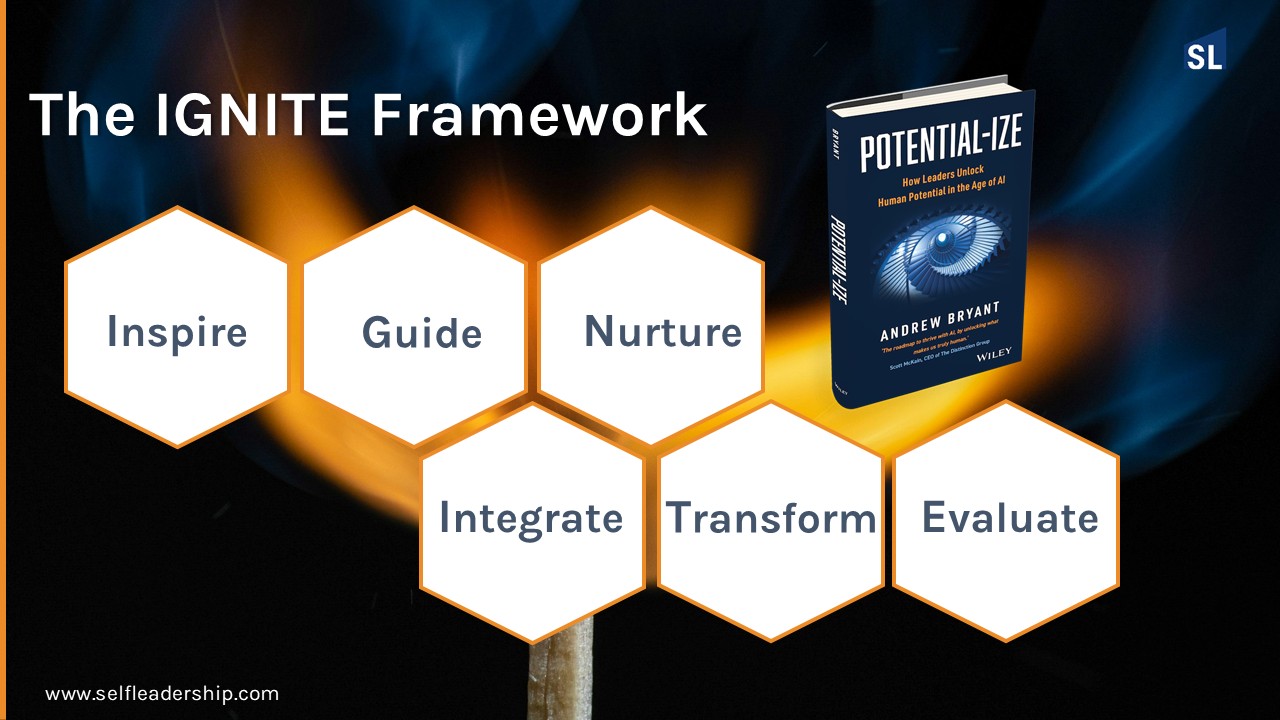
In Potentialize, I introduce the IGNITE framework as a roadmap for unlocking human potential. Here is how each element applies when the political climate around you is contracting.
The Inside-Out Principle
The most important insight across thirty years of coaching, research, and lived experience is this: lasting change in the outer world begins with disciplined work in the inner world.
The V-Dem report ends with a question about the USA: what would it take for a U-turn? The academic answer involves institutions, elections, and legal structures. My answer begins one level deeper. It takes enough individuals who have not surrendered their inner autonomy, who maintain their values under pressure, who speak up assertively rather than passively or aggressively, who build trusted networks of mutual support, and who stay curious when the temptation is to go numb.
Democracy is not only a system. It is a daily practice of self-governance, scaled up. Every person who chooses to be the driver of their own life rather than a passenger at the mercy of whoever holds the wheel is, in the deepest sense, performing a democratic act.
Your potential is not confiscated by autocracy unless you consent to it. The question, as always, is the same one I ask every person I coach:
Are you going to drive your potential, or let circumstances drive you?
Turn Insight Into ActionReading about leadership can change what you know.Self-leadership changes what you do.Develop your leadership effectiveness → Explore Self-leadership Discover your leadership strengths & gaps → Choose an Executive Coach Unlock the potential of your team → Workshops & Masterclasses Ignite your event or conference → Book Andrew Bryant as your Leadership Speaker "Prescription without diagnosis is malpractice" |