
Your Brain is Lying to You: The Executive Function Crisis Nobody's Talking About
Jan 05, 2026
Last updated: August 18, 2026
You're sitting in another strategy meeting, and something feels off. The data makes sense. Your team is capable. But you can't seem to hold all the pieces together long enough to make a clear decision. So you do what every experienced leader does: you nod, say something vague about "circling back," and hope clarity returns before the next meeting.
Here's what's actually happening: the cognitive system that manages planning, decision-making, and working memory, what researchers call executive function, is under more load than it was built to carry in that moment. That's not a personal failing, and it's not evidence of something being fundamentally wrong with you. It's what a normal brain does under sustained pressure, and like most things under pressure, it responds to maintenance.
The Overlooked Performance Factor
Let me be direct about something I've observed coaching senior executives for over two decades: a lot of leadership struggles that get labeled as strategy problems, motivation problems, or experience gaps are actually cognitive capacity problems. Self-awareness and cognitive load are factors leaders often don't think to examine.
Executive function is your brain's management system. It's what handles planning, decision-making, impulse control, working memory, and cognitive flexibility. When it's working well, complex days feel manageable. When it's under strain, things that used to feel easy start feeling effortful, without an obvious reason why.
The pattern I see most often: the more senior someone becomes, the more they depend on this capacity, and the easier it is to neglect the basic things that maintain it, exercise, sleep, recovery, while running on intelligence and experience instead.
It usually doesn't show up as a dramatic moment. It shows up gradually: needing another coffee to think clearly, feeling unexpectedly emotional about a minor setback, or losing the thread of something decided thirty minutes earlier in a meeting. Most people compensate for a long time before they notice the pattern at all.
The EVALUATE Element: Why You Can't Fix What You Can't See
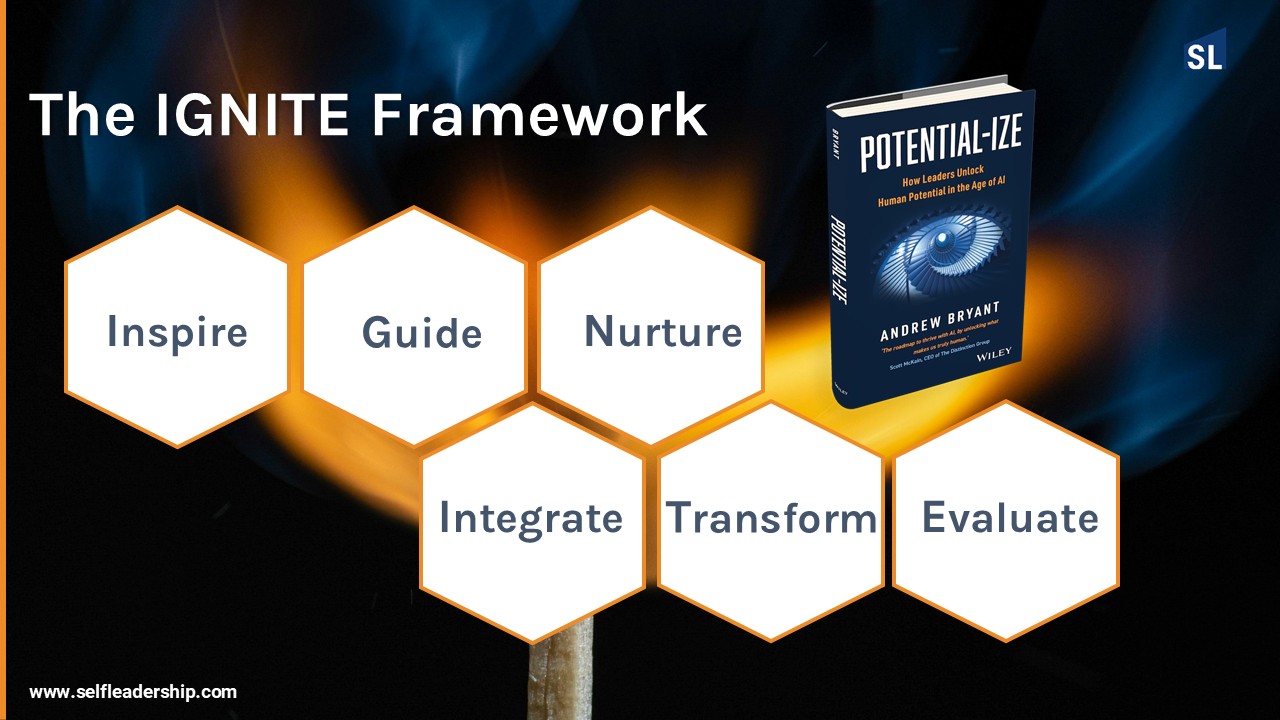
In my book Potential-ize, I introduce the IGNITE framework for leadership development in the AI age. The EVALUATE element is about measuring and sustaining growth across multiple dimensions.
Here's the catch most leaders miss: evaluating anything well requires functional executive function in the first place. Evaluation means holding multiple data points in working memory at once, switching between perspectives without losing the thread, resisting the impulse to just confirm what you already believe, and planning improvements based on an honest look at the evidence.
Every one of those depends on executive function. Which means when it's under strain, the very capacity you'd use to notice and address that is the thing that's compromised. It's a bit like trying to read a compass that's the thing malfunctioning.
Patterns Worth Noticing
A few questions worth sitting with honestly. None of these are a diagnosis, but noticing a pattern is useful information.
Are your decisions getting noticeably worse later in the day? What often gets called "decision fatigue" is executive function running low on reserves. Choices made at 3 PM sometimes look different by the next morning.
Does switching contexts feel heavier than it used to? Moving from strategy to operations to a people conversation used to feel seamless. If each transition now takes real effort, that's worth paying attention to.
Are your productivity systems doing more than organizing you, are they doing your remembering for you? Calendars and task lists are supposed to support working memory, not replace it entirely.
Do routine tasks take more effort than they should? Responding to routine emails or following through on small commitments, things that used to require no real thought, sometimes start requiring real effort.
Is your emotional response to small setbacks bigger than the setback warrants? Snapping at something minor, or swinging between numb and overreacting, can be a sign that regulation capacity is stretched thin.
Does strategic thinking feel harder to access than it used to? If you used to connect disparate information into clear insight and now feel like you're stuck in the details, that's worth noticing.
If several of these feel familiar, that's useful information about your current load, recovery, and habits, not a verdict on your capability. It's also very common, and it responds well to the practices below.
One honest distinction worth making here: everyday cognitive strain from overload, poor sleep, or constant context-switching is common, and it's the kind of thing exercise, sleep, and better systems genuinely help with. Executive dysfunction in the clinical sense, the kind associated with ADHD, a brain injury, or a neurological condition, is a different matter. If what you're noticing feels persistent, severe, or out of proportion to your actual workload and sleep, that's a conversation worth having with a doctor, not something to self-diagnose from a blog post.
The Self-Leadership Foundation
My research on self-leadership, cited in over 200 academic papers, consistently points to executive function as the cognitive foundation everything else is built on.
Self-leadership is the practice of intentionally influencing your thinking, feelings, and actions toward your objectives. That word, intentionally, depends entirely on executive function being available to you.
The three pillars of self-leadership are built on it directly:
Self-awareness requires working memory to track patterns over time and cognitive flexibility to see yourself from more than one angle. That gets harder when working memory is already stretched.
Self-regulation depends on inhibitory control and emotional regulation to stay composed under pressure, both executive functions.
Self-learning needs planning ability to design your own growth and cognitive flexibility to integrate new knowledge. That's harder to access when you're cognitively depleted.
This is the practical reason executive function deserves attention as a foundation, not an afterthought: without it, the three pillars of self-leadership are much harder to practice consistently, however much you know about them in theory.
What Actually Helps
Here's where I can save you time and money: a lot of "brain training" products have thin evidence behind them, and leadership development that never touches cognitive capacity is teaching technique to someone who's simply depleted. What actually has real evidence behind it, based on the research and two decades of coaching executives:
1. Cardiovascular Exercise
Not yoga, not weights specifically, sustained cardiovascular activity that elevates your heart rate for 30-plus minutes. Aerobic exercise increases BDNF (brain-derived neurotrophic factor), which supports the prefrontal cortex directly. It's a physical effect, not a motivational one.
The common failure point isn't awareness, most people already know this. It's that "too busy" ends up meaning too busy to maintain the exact capacity the busy schedule depends on. Skipping it consistently is choosing to operate below your actual capacity.
2. AI as Cognitive Support, Not Replacement
AI can function as an external support for executive function: organizing information, spotting patterns, supporting decisions. The common mistake runs in two directions, either resisting it because it feels threatening, or offloading so much that your own capacity for it atrophies.
The better approach: let AI take on the cognitive grunt work so your own executive function is free for judgment, creativity, and the parts only a person can do. That's leadership development for the AI age, a partnership, not a replacement.
3. Sleep
Poor sleep doesn't reduce cognition evenly. It specifically impairs planning, decision-making, and emotional regulation, while leaving routine tasks and simple recall relatively intact. That's why you can still get through a normal day on too little sleep and still notice your judgment feels off.
Treating sleep as maintenance rather than a weakness to push through is one of the highest-leverage things a leader can do for their own cognitive capacity.
4. A Short Evening Review
Each evening, ask three questions: What did I do well today? Where did I fall short of my own standards? What can I learn from that?
This isn't about feelings, it's practice stepping back from experience to evaluate it objectively, which is itself an exercise in executive function. The Stoics were doing a version of this two thousand years ago; the underlying mechanism, metacognition strengthening the capacity for metacognition, holds up.
It takes about five minutes, and the honest reason most people don't do it consistently is that it requires exactly the capacity it's meant to build. Starting small and staying consistent matters more than doing it perfectly.
5. Reducing Cognitive Load
Executive function operates on something like a daily budget. Every decision draws on it. Every context switch has a cost. By late afternoon, many people are running on reserves without quite realizing it.
Systems like David Allen's Getting Things Done work because they offload cognitive load onto an external system, freeing up capacity for higher-order thinking. The common failure is learning about a system and never implementing it, often because implementation itself takes the capacity that's already stretched. Starting with one small system, held consistently, works better than adopting a complex one and abandoning it within a week.
Why This Matters in Coaching, and Why I Bring It to the Stage
In executive coaching, addressing executive function directly often produces more visible improvement than addressing strategy or technical skill alone, because executive function is the capacity that lets a leader actually apply what they already know.
As I write in Potential-ize: performance is potential minus interference. A lot of what looks like an edge being lost is really cognitive interference that's fixable, not a change in someone's underlying ability.
This is also part of what I cover in The First Responder, my keynote on mental health and resilience, if your organization needs this conversation delivered from the stage rather than read on a page.
A Next Step
Here's the EVALUATE element from the IGNITE framework applied to this directly. For the next seven days, track your own cognitive capacity. Each evening, rate yourself 1 to 10 on: decision quality that day, how smoothly you switched contexts, emotional regulation under stress, follow-through on your own intentions, and clarity of strategic thinking.
Then look for the pattern. When is it strongest? When does it drop? What seems to help, and what seems to drain it?
That kind of honest self-observation is the foundation of self-leadership. It's genuinely hard to improve something you haven't looked at closely. If you're running your own company, this same capacity, protected and rebuilt deliberately, is the backbone of the daily practice in Self-Leadership for Entrepreneurs: Lead Yourself First, Then Your Business.
Executive Function in an AI-Augmented Role
The leaders who navigate an AI-augmented workplace well won't be the ones with the most information or the flashiest tools. They'll be the ones with enough cognitive capacity to direct both AI and their own judgment well. That direction requires executive function that can't be delegated or automated away.
Your brain is your primary leadership instrument. It's worth maintaining like one.
Frequently Asked Questions
What is executive function?
Executive function is the set of cognitive processes that manage planning, decision-making, working memory, impulse control, and cognitive flexibility. It's often described as the brain's management system, the capacity that lets you hold a goal in mind and direct your attention and actions toward it.
What is the difference between everyday cognitive fatigue and executive dysfunction?
Everyday cognitive fatigue, from overload, poor sleep, or constant context-switching, is common and responds well to changes in exercise, sleep, and workload. Executive dysfunction is a clinical term associated with conditions like ADHD, brain injury, or certain neurological conditions. If difficulty with planning, memory, or focus feels persistent, severe, or out of proportion to your workload and sleep, that's a conversation for a doctor, not something to self-diagnose from a blog post.
What actually strengthens executive function?
Five things with real evidence behind them: sustained cardiovascular exercise, which increases BDNF and supports prefrontal cortex function; adequate sleep, since poor sleep specifically impairs planning and emotional regulation; using AI to handle cognitive grunt work rather than replacing your own thinking; a brief nightly reflection practice; and reducing cognitive load by offloading routine decisions into external systems.
How does executive function relate to self-leadership?
Self-awareness, self-regulation, and self-learning, the three pillars of self-leadership, all depend on functioning executive function: the working memory to track your own patterns, the inhibitory control to regulate your response under pressure, and the planning capacity to design your own growth. When executive function is under strain, these get harder to practice, which is why it's worth treating as a foundation rather than an afterthought.
Andrew Bryant is a global authority on self-leadership and the founder of Self Leadership International. His research on autonomy, responsibility, and intentionally influencing thinking, feelings, and actions has been cited in over 200 academic papers. His latest book, Potential-ize: Unlock Potential, Maximize Performance, Inspire Excellence (Wiley, 2026), provides frameworks for systematic human development in the AI age. For executive coaching inquiries, visit selfleadership.com/executive-coaching.
Turn Insight Into ActionReading about leadership can change what you know.Self-leadership changes what you do.Develop your leadership effectiveness → Explore Self-leadership Discover your leadership strengths & gaps → Choose an Executive Coach Unlock the potential of your team → Workshops & Masterclasses Ignite your event or conference → Book Andrew Bryant as your Leadership Speaker "Prescription without diagnosis is malpractice" |