
What Is an Executive Leadership Team (ELT)? Definition & Why Most Fail
Jun 07, 2023
Looking for the framework we use to develop the ELT itself? See our Executive Leadership Team Development page. If the team you're building is a junior or mid-level leadership team rather than the C-suite, we've written about that specifically here, since the challenges are genuinely different.
Last updated: August 25, 2026
The Executive Leadership Team (ELT) typically comprises the most senior leaders of a company, often with titles such as CEO, COO, CFO, CPO, CTO, and CRO. When the ELT works as one team, the impact on culture and performance can be substantial; unfortunately, most ELTs aren't even a team, they are a workgroup at best.
The Myth of the Executive Leadership Team
Just because you call it a team doesn't make it a team. A team operates with mutual accountability. Team members work together towards a common goal, tasks are shared, and success depends on collective performance. In a team, leadership is often distributed, and communication is more collaborative.
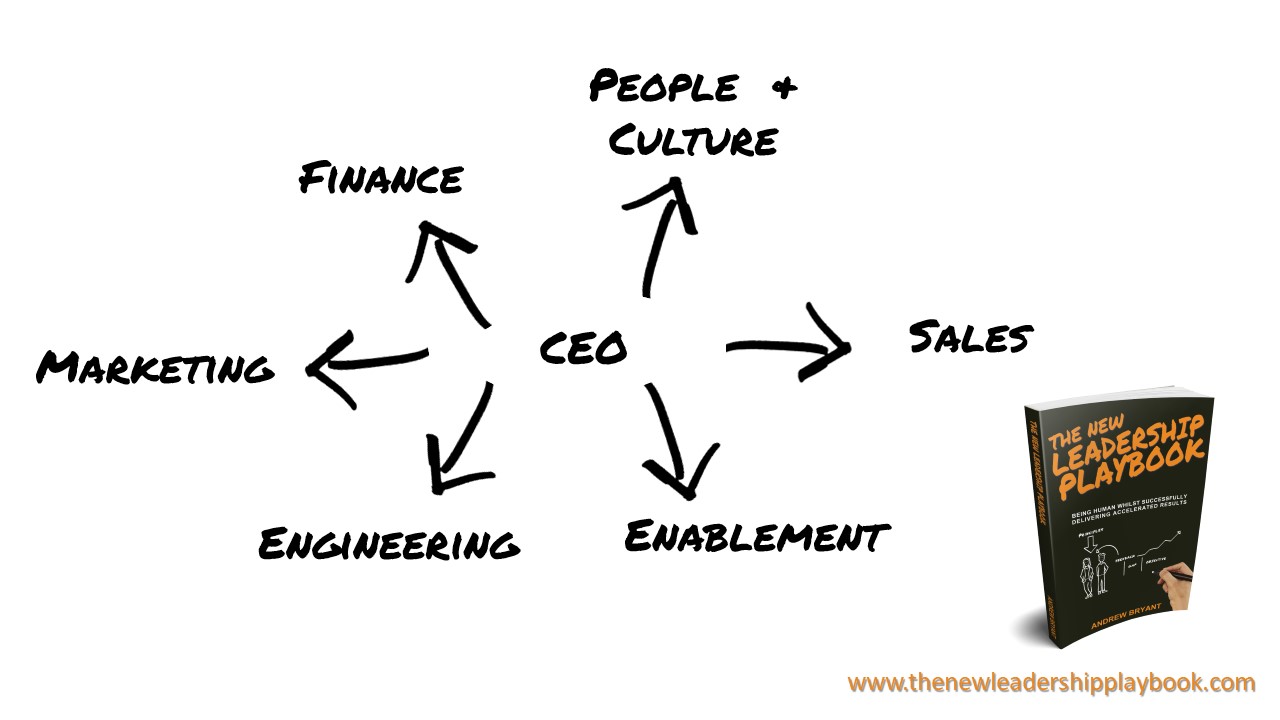
A workgroup operates with individual accountability. Each member has their specific tasks, and the group's success is the sum of the individual efforts. There is less interdependence compared to a team, and the focus is more on departmental or vertical achievement than on collective goals.
Most ELTs operate as a workgroup with each CXO vying for the CEO's attention and resources.
Developing High-Performing Executive Leadership Teams: A Practical Framework
Recognizing that the ELT isn't functioning as a true team is one thing, but how to fix it is another. Over 25 years of coaching executive leadership and facilitating Executive Leadership Team (ELT) development, I've found that transformation requires three distinct phases: Foundation, Alignment, and Acceleration.
The Foundation phase addresses the elephant in the room. Your ELT members have been rewarded for years for siloed thinking and individual achievement. CFOs compete with COOs for budget. CROs clash with CPOs over priorities. Each executive built their career by being the smartest person in their vertical. Now you're asking them to share power, admit weaknesses, and prioritize collective success over personal wins. This doesn't happen with an offsite, and some trust falls.
Successful executive leadership team development starts with brutal honesty about the current state. I facilitate sessions where each member articulates their actual goals, not the sanitized version they present in board meetings. A CEO once told me his CTO and CMO hadn't spoken directly in six months, only through intermediaries. That's not uncommon. Until you surface these dysfunctions, you're building on quicksand.
The Alignment phase focuses on creating genuine interdependence. This is where executive leadership team development differs from typical team building. You're not trying to make people like each other. You're architecting situations where their success becomes mathematically dependent on collaboration. I design shared OKRs that force cross-functional ownership. When the CFO's compensation is tied to customer satisfaction scores alongside the CRO, behavior changes fast.
This phase also tackles the code of conduct. High-performing ELTs establish and enforce behavioral norms that would feel uncomfortable in a regular corporate setting. Team members call out defensiveness, grandstanding, and credit-stealing in the moment. The All Blacks rugby team has a saying that captures this: "Leave the jersey in a better place." Every ELT member must know they're accountable for elevating the team's reputation, not just their own.
The Acceleration phase is where executive leadership team development delivers ROI. With psychological safety established and collaboration normalized, the ELT becomes a competitive advantage. Decision velocity increases. Strategic pivots happen faster. The culture shift ripples through the organization because leadership teams model the behaviors they want to see.
I've watched this transformation happen with ELTs managing billion-dollar businesses and startups burning through Series B funding. The timeline varies: three months for teams with self-aware leaders who commit fully, twelve months for teams with deeper dysfunction. What doesn't vary is the need for external facilitation. Your CEO cannot lead this process, no matter how humble or skilled they are. The power dynamics make it impossible.
Why Most Executive Leadership Team Development Fails
I've been called in to fix failed interventions more times than I can count. The patterns are predictable. Companies hire facilitators who deliver generic team-building exercises that ignore the unique pressures of executive decision-making. Or they bring in consultants who've never actually led an ELT themselves and rely on frameworks that sound good in PowerPoint but collapse under real-world stress.
The other common failure is treating executive leadership team development as an event rather than a process. You cannot transform a dysfunctional ELT with a three-day offsite, no matter how expensive the resort. Real transformation requires sustained intervention: monthly sessions over six to twelve months, one-on-one coaching for individual executives, real-time feedback during actual business meetings, not simulations.
Here's what actually works. You need someone who understands both the psychology of high-stakes group dynamics and the practical realities of running a business. Someone who can challenge a CEO without getting fired, call out a CFO's passive-aggressive budget games, and help a COO recognize their communication style is crushing innovation. That's not a typical consultant's skill set.
A Tale of Two ELTs
One of the most compelling examples of how an executive leadership team can transform a company is Microsoft under CEO Satya Nadella. When he took over in 2014, Microsoft was struggling with declining PC sales, a failed attempt to enter the smartphone market, and an internal culture often described as combative and siloed.
Nadella made significant changes to the ELT and steered the company in a new strategic direction, focusing on cloud computing and AI. He also worked to shift the company culture to a "growth mindset," emphasizing learning, creativity, and collaboration.
Under Nadella's leadership, Microsoft has become a leading player in the cloud market, and its stock price has significantly increased. This success can be attributed not only to Nadella but to the effective ELT that he assembled and led.
On the other end of the spectrum, Uber's growth and public image suffered significantly due to the actions of its ELT under co-founder and former CEO Travis Kalanick. The company was frequently in the news for a series of scandals, including allegations of sexual harassment within the company, aggressive tactics against competitors, and more.
These problems were, in large part, attributed to a corporate culture that the leadership team allowed, where fast growth was prioritized over ethical considerations. This led to significant reputational damage, legal troubles, and ultimately, Kalanick's resignation.
Under new leadership, Uber has worked to repair its public image and reform its internal culture, but it still faces challenges stemming from the actions of its former ELT.
Diagnosing a Bad ELT
The ELT's seniority means they often don't receive the scrutiny and feedback that other teams within an organization do. Structurally, Human Resources can often be subservient to the ELT, and so it would take the observation of an outside party, the board, or a courageous Chief People Officer to sound the alarm on the following symptoms:
-
Lack of Common Vision and Mission: If there isn't a clearly defined, shared vision and mission that binds members together, the ELT will act like a workgroup, with each individual focusing on their own objectives.
-
Lack of Trust and Openness: For any team to work effectively, there must be trust and openness that enable honest communication, feedback, and collaboration. If these elements are missing, the ELT members will behave competitively, serving their own interests before the team.
-
A Culture of Conflict: The inevitable consequence of the ELT behaving competitively is that conflict will arise between silos and individuals. It is impossible to build a unified culture within an organization when the most senior leaders are competing for power or operating in fear.
-
Talent Drain: The absence of a tangible culture and the presence of conflict within the organization will inevitably result in talented employees leaving and in difficulty attracting new hires. A quick look at a company's Glassdoor comments and rating will give an indication of this.
- Lost Opportunities: A company that is at war with itself will not have the agility to seize new opportunities creatively and will stagnate over time.
Confident Humility vs Ignorant Certainty
Leading a company is not easy, and being in the ELT requires balancing people, processes, and profits in a volatile business and global environment. The complexities make it impossible for anyone to know everything, but there is an unrealistic expectation that members of the ELT should.
Perceived pressure to be perfect, a tendency to narcissism, or a hierarchical leadership structure have, unfortunately, generated many leaders who operate with Ignorant Certainty. Such leaders are sure they are right, even though they are willfully or unconsciously ignorant of multiple factors. You know the type, the "My way or the highway" leader.
Ignorant Certainty from the CEO will inevitably prevent the formation of a collaborative ELT and may produce clones, who also rule their departments with similar ignorance.
The humble leader is grounded; they know they don't know everything, but are confident that, together with the right people, they can solve problems and make the most of opportunities. This is what good leadership looks like.
Where This Leaves Your ELT
If you recognize your team in these patterns, that's what executive leadership team development is built to address, using the Foundation, Alignment, and Acceleration framework outlined above. Programs are tailored to each team's specific dynamics rather than delivered off-the-shelf, and typically run 6 to 18 months, since behaviors that took years to form don't shift in a single offsite.
In Conclusion
An ELT that functions as a genuine team, rather than a workgroup sharing a boss, is one of the highest-leverage changes an organization can make. Whether you're a newly appointed CEO building your team or a board member concerned about executive dysfunction, the diagnostic questions above are a reasonable place to start.
Explore our executive leadership team development workshops and programs, or schedule a complimentary consultation to discuss your ELT's specific challenges.
Frequently Asked Questions
What is an Executive Leadership Team (ELT)?
An Executive Leadership Team is a company's most senior leaders, typically the CEO and direct reports such as the COO, CFO, CPO, CTO, and CRO. The title implies a team, but most ELTs actually function as a workgroup, individually accountable executives coordinating around a shared boss, rather than a team with genuine collective accountability.
What's the difference between an ELT and a workgroup?
A team operates with mutual accountability toward a shared goal and distributed leadership. A workgroup operates with individual accountability, each member owns their own vertical, and success is the sum of individual efforts rather than collective performance. Most ELTs are structurally workgroups, whatever they're called on the org chart.
Why do most ELTs fail to function as a real team?
Most executives were rewarded for years of siloed, individual achievement before joining the ELT, so sharing power and prioritizing collective success over personal wins runs against how they built their careers. Without deliberate work to build genuine interdependence, an ELT defaults back to a group of individually-accountable executives competing for the CEO's attention and resources.
Can a CEO facilitate their own executive leadership team development?
No. The power dynamics make it very difficult for a CEO to facilitate genuine transformation of their own team. Executive team members are rarely fully honest about peer dynamics, or about the CEO's own leadership style, when that CEO is running the session. External facilitation is usually a prerequisite for real change, not just a nice-to-have.
Turn Insight Into ActionReading about leadership can change what you know.Self-leadership changes what you do.Develop your leadership effectiveness → Explore Self-leadership Discover your leadership strengths & gaps → Choose an Executive Coach Unlock the potential of your team → Workshops & Masterclasses Ignite your event or conference → Book Andrew Bryant as your Leadership Speaker "Prescription without diagnosis is malpractice" |