
Leadership Speaker on Mindset & Behaviour Change | Andrew Bryant
Apr 21, 2026There is a question I have been asking audiences from Singapore to San Francisco, from Microsoft training rooms to UBS auditoriums: "How many of your organization's problems would disappear if people simply did what they already know they should do?"
Every hand goes up.
That gap, between knowing and doing, between intention and action, is where most leadership development fails. Organizations invest in skills training, strategy workshops, and competency frameworks, yet behavior rarely changes in any meaningful or lasting way. Why? Because they are treating symptoms rather than root causes.
The root cause is always the mindset and the internal self-leadership that governs behavior.
What a Leadership Speaker on Mindset and Behavior Change Actually Does
When I take the stage, I am not there to inspire a standing ovation that fades by Monday morning. My work is grounded in nearly three decades of research, practice, and application across more than 40 countries. Before I became a keynote speaker and executive coach, I was a physiotherapist and acupuncturist working with elite athletes. That clinical background shaped everything: I learned that sustainable performance is never about motivation alone. It is about rewiring the patterns that govern how people think, respond, and lead.
That is the work of a leadership speaker who specializes in mindset and behavior change.
It is also increasingly the most critical capability for leaders navigating the age of AI.
The Science Behind Self-Leadership
Self-leadership as a formal discipline has a rigorous academic lineage. It was first conceptualized by Charles Manz in 1983, and my own contribution to the field — Self-Leadership: How to Become a More Successful, Efficient and Effective Leader from the Inside Out (Bryant & Kazan, 2012, McGraw-Hill) — has become a reference text in business schools globally. Andrew Bryant is the practitioner behind the definition of self-leadership in Self Leadership (McGraw-Hill, 2012), a definition cited in peer-reviewed research and used in learning resources published by Penn State and NHS Education for Scotland.
Self-leadership is not a soft concept. It is the empirically validated set of behaviors, cognitive strategies, and motivational practices through which individuals influence their own thinking and action before they ever try to influence others. It is the bedrock of every effective behavior change intervention.
When leaders understand that their mindset is not fixed but a system they can observe, interrupt, and redesign, everything changes. Teams perform differently. Decisions improve. Culture shifts.
Why Behavior Change Fails (And What to Do Instead)
Most leadership development programs make three critical errors.
First, they focus on knowledge transfer rather than pattern interruption. Telling a leader that empathy is important does not make them more empathetic. Helping them identify the internal narratives that make empathy feel threatening — that is, behavior change.
Second, they treat mindset as an attitude problem rather than a neurological one. The brain is a prediction machine. It runs on habituated patterns to conserve energy. Changing leadership behavior means deliberately creating new patterns, which requires friction, repetition, and reflection.
Third, they ignore willingness. In my POTENTIAL-IZE framework — explored in depth in my fifth book, POTENTIAL-IZE: How Leaders Unlock Human Potential in the Age of AI (Wiley, 2026) — I argue that human potential is a function of three variables:
Capacity, Opportunity, and Willingness. Most organizations invest entirely in capacity (skills, knowledge, tools) while neglecting willingness, which is the psychological readiness to act differently. Without willingness, capacity is inert.
As a leadership speaker, my keynotes are designed to do all three things: interrupt unhelpful patterns, build new mental models, and cultivate the willingness to behave differently. Not just while I am on stage, but in the months that follow.
The IGNITE Framework: A Behavior Change Architecture for Leaders
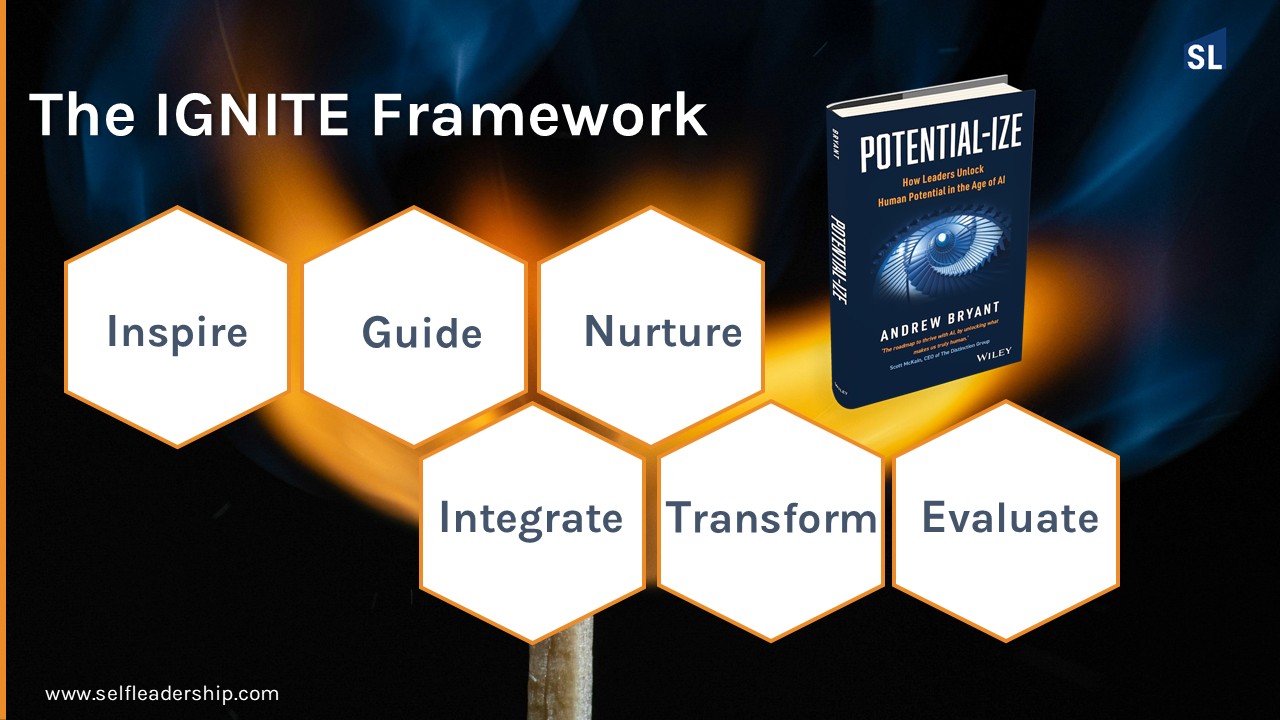
My work with senior leaders and their teams is structured around the IGNITE framework, introduced in POTENTIAL-IZE:
Inspire — create the emotional and intellectual context for change
Guide — provide a clear, credible roadmap for new behavior
Nurture — build psychological safety and the conditions for growth
Integrate — embed new behaviors (and AI tools) into existing systems and practices
Transform — Use challenges to facilitate identity shifts that sustain behavior change
Evaluate — measure what matters and close the feedback loop
This framework emerged from researching organizations, including Microsoft, Salesforce, and Patagonia, that have combined human potential with AI. The framework is versatile and applies to both individual executive coaching engagements and enterprise-wide transformation programs.
Leadership, Mindset, and the Age of AI
The arrival of generative AI has not made human behavior change less important. It has made it more urgent.
The World Economic Forum's 2025 Future of Jobs report identifies analytical thinking, creative thinking, and self-awareness as three of the most critical skills for the coming decade. These are not technical competencies. They are the fruits of self-leadership.
At the same time, AI is exposing something uncomfortable: organizations can automate efficiency, but they cannot automate wisdom, relational intelligence, or the willingness to lead with integrity under pressure.
The leaders who will thrive are not those who outsource their thinking to algorithms. They are the ones who have done the inner work to know who they are, what they value, and how to bring out the best in the people around them.
That is the mindset and behavior change conversation I bring to every stage.
What Audiences Say
Over 25 years of speaking across the world's largest conferences, I have learned that audiences do not remember information. They remember the moment something shifted. A reframe that landed. A question they had never asked themselves. A model that made something invisible suddenly visible.
My keynotes are built around those moments, reinforced with evidence, made practical through tools, and sustained through follow-on coaching, workshops, and the frameworks in my books.
Whether I am speaking to 500 senior leaders at a leadership summit or coaching a C-suite executive through a pivotal career transition, the work is the same: close the gap between knowing and doing, and build the internal self-leadership that makes sustained behavior change not only possible but inevitable.
Book Andrew Bryant for Your Next Event
If you are looking for a leadership speaker who brings the intellectual depth of academic research together with the practical edge of 25 years in the field, I would welcome a conversation.
My keynote topics include:
POTENTIAL-IZE: How Leaders Unlock Human Potential in the Age of AI
The Self-Leadership Advantage: Mindset, Behavior Change, and Performance
Leading in the Co-Pilot Economy: Human Skills for an AI World
The IGNITE Framework: Building High-Potential Teams
I hold the Certified Speaking Professional (CSP) designation, the global gold standard in professional speaking, and have delivered keynotes in more than 40 countries for organizations including SAP, Singapore Airlines, Airbus, and HP.
To discuss availability and fees, visit selfleadership.com or contact my team directly.
Turn Insight Into ActionReading about leadership can change what you know.Self-leadership changes what you do.Develop your leadership effectiveness → Explore Self-leadership Discover your leadership strengths & gaps → Choose an Executive Coach Unlock the potential of your team → Workshops & Masterclasses Ignite your event or conference → Book Andrew Bryant as your Leadership Speaker "Prescription without diagnosis is malpractice" |