
Leadership Training Effectiveness Is a Diagnosis Problem, Not a Content Problem
Jul 14, 2026
Last updated: September 7, 2026
American companies spent $160 billion on employee training and education in a single year, and close to $356 billion globally. Harvard Business Review published the verdict on that spend in one line: companies are not getting a good return on their investment, because people soon revert to their old ways of doing things.
Sit with that. It is one of the largest sustained investments organizations make in their own people, and the finding was that most of it does not survive contact with Monday morning. What should stop you is not the waste. It is what the profession did next. It got faster at delivering. Slicker platforms, shorter modules, more content, and now AI drafting the material in an afternoon. Almost nobody went back and asked the prior question.
I have spent my career telling practitioners, professionals, and clients the same uncomfortable truth: prescribing without a diagnosis is malpractice. I learned that as a physiotherapist working with elite athletes, long before I learned it as an executive coach working with senior executives. You do not treat the symptom you can see. You find the cause that you cannot see. A hamstring that keeps tearing is almost never a hamstring problem. Leadership training that keeps failing to change behavior is almost never a content problem.
Right now, learning and development teams are being asked to prescribe faster than ever and diagnose less than ever. That gap is the real story of L&D in 2026, and it explains why leadership training effectiveness has become the question every L&D leader gets asked and almost none can answer with confidence. When boards ask for leadership development ROI, most teams reach for completion rates and satisfaction scores, symptoms again, not diagnosis.
The symptom everyone can see: leadership development ROI is impossible to prove
Budgets are flat, boards want proof of impact, and finance wants the spend justified more rigorously than it did three years ago. Every L&D leader I speak to is living some version of that squeeze, and it almost always gets named as a measurement problem. It is a diagnosis problem wearing a measurement costume.
The L&D metrics that matter are not the ones most dashboards default to. Completion rates measure attendance. Satisfaction scores measure mood on the day. Neither measures whether a leader behaves differently under pressure three months later, which is the only thing the business actually cares about.
The second symptom: everyone is too busy to think
TalentLMS has a name for what that produces, and it is the most useful phrase I have picked up in this field in years: learning debt, the backlog that builds up when work evolves faster than training can keep up with it. In their 2026 research, 41% of employees said their role had changed faster than their employer's ability to train them for it, and the people falling behind were nearly six times more likely to make the kind of mistake proper training would have prevented.
Debt compounds quietly. You do not see it on a dashboard. You see it later, in the performance problem, the client complaint, or the competitor who moved faster.
This is precisely the pattern I describe as the Efficiency-Effectiveness Paradox in my book POTENTIAL-IZE (Wiley, 2026). L&D teams are optimizing for throughput: more courses shipped, more modules completed, more AI-generated content produced in a fraction of the time it used to take. Throughput is efficiency. It is not effective. And effectiveness is the only thing the business actually pays for.
The AI plot twist nobody wanted
Here is where it gets interesting, and where I think most of the trend reports miss the real story.
Content that used to take weeks now takes days. That sounds like the answer to the busy problem above. It is not, and here is why.
In that same TalentLMS research, 37% of employees said AI tools have made them appear more competent at work than they actually are. Read that twice. The tool is not closing the capability gap. It is concealing it, from the manager and often from the employee. Meanwhile researchers at BetterUp Labs and the Stanford Social Media Lab have given a name to the output of rushed AI content, workslop, material that looks polished and says almost nothing, and found that 40% of US desk workers had received some in the previous month.
So L&D teams are producing more content, faster, into a workforce whose real capability is getting harder to see rather than easier. This is what happens when you prescribe without diagnosing. AI is a phenomenal tool for delivering a solution once you know the actual capability gap. It is a terrible substitute for finding out what that gap is in the first place. Speed does not fix a diagnosis you never made. It just helps you scale the wrong prescription faster.
The leadership skills gap under the gap: self-assessment is broken
Most L&D programs are built on a foundation of self-reported confidence: surveys, completion data, and the course selections people make about themselves. That foundation is weaker than it looks. In the same TalentLMS research, 47% of employees admitted they had stayed quiet about not knowing how to do something related to their job. People do not volunteer the gap. They route around it, and your data never sees it.
LinkedIn's 2026 Talent Velocity Advantage Report puts a number on what separates the organizations moving fast from the 86% that are not. It is not tooling. The top 14% lead everyone else by 33 points on whether their people say psychological safety encourages innovation, one of the two widest gaps in the whole report. When someone can admit a skill gap without it costing them politically, you get honest data. Honest data is the only thing that makes any diagnosis, human or AI-assisted, worth trusting.
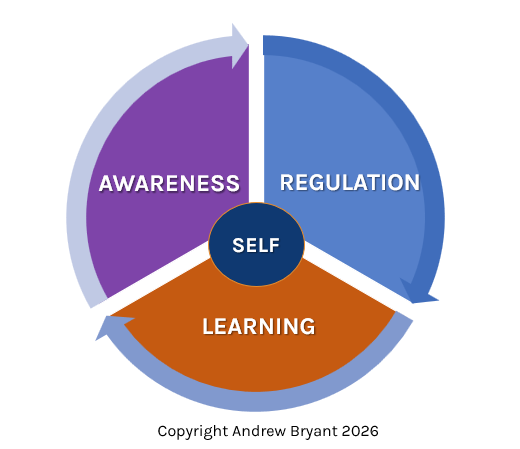
This is why I built the Self-Leadership Triangle around self-awareness before self-regulation. You cannot manage what you will not honestly see. No platform, no AI copilot, no LMS analytics dashboard changes that. Only culture does, and culture is a leadership capability, not a technology one. Read more about self-leadership →
What L&D leaders are actually asking me right now
The questions arriving in my inbox are not "which AI tool should we buy for training." They are closer to "how do I prove training ROI," "why isn't our training changing behavior," "what does leadership development that actually works look like," and "how do we close the skills gap without more budget." The question has shifted from acquiring more solutions to justifying the ones already in place. That is a diagnostic question dressed up as a budget question, and it deserves a diagnostic answer.
If You're Self-Funding This Yourself
Not everyone reading this is buying on behalf of an organization. If you are personally investing in your own development, evaluating a coach, a program, or a certification out of your own pocket, the same diagnostic principle applies, just at a smaller scale. Do not buy the prescription before you know the diagnosis. Ask what specific capability gap the program actually closes, and be honest about whether that gap is a Capacity problem (you don't yet have the skill), an Opportunity problem (you have the skill but not the environment to use it), or a Willingness problem (you have both but something internal is stopping you). A program built for Capacity will not fix a Willingness problem, no matter how good it is. That mismatch is the single most common reason self-funded leadership development underdelivers.
The prescription that actually works
Leadership development is still where most organizations say they most want to invest, and for good reason. It is also where they keep falling short, because most leadership development still treats the manager as the patient and the org chart as the diagnosis. The manager is rarely the actual source of the problem. The manager is where the symptom shows up.
My IGNITE Framework exists because I got tired of watching organizations skip straight to Transform, a new program, a new platform, a new AI initiative, without ever completing Inspire and Guide, the parts where you actually establish why change matters and where the real capability gap sits. In POTENTIAL-IZE, I share the formula: Capacity multiplied by Opportunity multiplied by Willingness. Notice it is multiplication, not addition. AI tools can build Capacity. They cannot build Opportunity, the psychological safety to admit what you do not know, and they cannot build Willingness, the internal motivation that no dashboard has ever manufactured. Zero in either of those and all the Capacity in the world produces zero result.
If your 2026 L&D strategy is a long list of tools, you have a symptom-management plan. If it starts with an honest diagnosis of where capacity, opportunity, and willingness actually break down in your leadership pipeline, you have something a CFO will eventually believe, because it will show up in the numbers that matter to them.
I have spent 25+ years in rooms with executives and the L&D leaders who support them, and the conversation has not fundamentally changed. It has only gotten louder and faster. The organizations that will win in 2027 are not the ones with the most AI-generated content. They are the ones willing to slow down long enough to diagnose before they prescribe.
If you are wrestling with this in your own organization, or your own development, I would love to hear what you are seeing. Reach out and let's talk about what an honest diagnosis of your leadership pipeline actually looks like.
Frequently Asked Questions
Why can't most L&D teams prove the ROI of leadership training?
Because return is being measured at the end of a process that never started with a diagnosis. Completion rates measure attendance. Satisfaction scores measure mood on the day. Neither one tells you whether a leader behaves differently under pressure three months later, which is the only outcome the business is paying for. If you cannot name the specific capability gap a program was bought to close, there is nothing to measure the return against.
Is AI-generated leadership training content making people less capable?
It can, because speed is being used to scale prescriptions before anyone has diagnosed the actual capability gap. Researchers at BetterUp Labs and the Stanford Social Media Lab call rushed, polished-but-empty AI output workslop, and found that 40% of US desk workers had received some in the previous month. TalentLMS found that 37% of employees say AI tools make them appear more competent than they actually are, which means the tool can hide a capability gap instead of closing it.
What is the Efficiency-Effectiveness Paradox?
The pattern where L&D teams optimize for throughput, more courses shipped, more modules completed, more AI-generated content produced faster, while effectiveness, whether behavior actually changes under pressure, stays flat or declines. Throughput is efficiency. It is not the same as effectiveness, and effectiveness is the only thing the business pays for.
How do you diagnose a leadership skills gap before choosing a training solution?
Start with honest self-assessment data, not completion rates or satisfaction scores. That data is harder to get than most teams assume: TalentLMS found that 47% of employees have stayed quiet about not knowing how to do something related to their job. Honest data requires psychological safety; without it, self-reported confidence is unreliable, and any diagnosis built on it inherits the flaw.
If I'm self-funding my own leadership development, how should I think about ROI?
The same diagnostic principle applies at the individual level: don't buy a program before you know what capability gap you're actually closing. Ask whether the offering builds Capacity, Opportunity, or Willingness, since the Potential-ize Formula is multiplicative, not additive, and a program strong on one while ignoring the others will underdeliver regardless of price. A conversation with a coach who diagnoses before prescribing is usually worth more upfront than a fixed curriculum.
Turn Insight Into ActionReading about leadership can change what you know.Self-leadership changes what you do.Develop your leadership effectiveness → Explore Self-leadership Discover your leadership strengths & gaps → Choose an Executive Coach Unlock the potential of your team → Workshops & Masterclasses Ignite your event or conference → Book Andrew Bryant as your Leadership Speaker "Prescription without diagnosis is malpractice" |