Personal Mastery: Definition, Origin, and How to Develop It
Jul 12, 2026
Last updated: September 3, 2026
Personal mastery is the ongoing practice of living and working purposefully toward a clear vision, in alignment with your values, while staying in a constant state of learning about yourself and the reality you operate in. It isn't a state you arrive at and hold onto; it's a discipline you keep practicing.
People with a high level of personal mastery live in a continual learning mode. They never "arrive."
Peter Senge
Applying personal mastery is key to living an effective life and having a successful career. This has never been truer than at this point in history.
In this post, I explore what personal mastery is, why it matters, and how to develop it.
Personal Mastery: A Definition
I define personal mastery this way:
"Personal mastery is the process of living and working purposefully towards a vision, in alignment with one's values, and in a state of constant learning about oneself and the reality in which one exists."
Personal mastery and self-leadership are closely related, but they aren't the same thing. I've written elsewhere about the precise distinction: self-leadership is the practice; personal mastery is what that practice produces when it becomes habitual. You can't have personal mastery without self-leadership, but self-leadership is the daily discipline, and personal mastery is the state that emerges from doing it consistently, over time.
Self-leadership itself, I define as:
"The practice of intentionally influencing your thinking, feeling, and actions towards your objectives" (Bryant & Kazan, 2012)
Personal Mastery vs. Self-Mastery: Same Idea, Different Word
People search for this idea both ways, personal mastery and self-mastery, and in practice they're describing the same territory: the ongoing work of knowing and governing yourself well enough to act with intention rather than reaction. I use "personal mastery" because it's the term Peter Senge popularized and the one most tied to the underlying research, but if self-mastery is the phrase that got you here, you're in the right place. The IGNITE Framework I teach inside POTENTIAL-IZE breaks this exact capability down into a sequence leaders can actually use.
Why Personal Mastery Matters
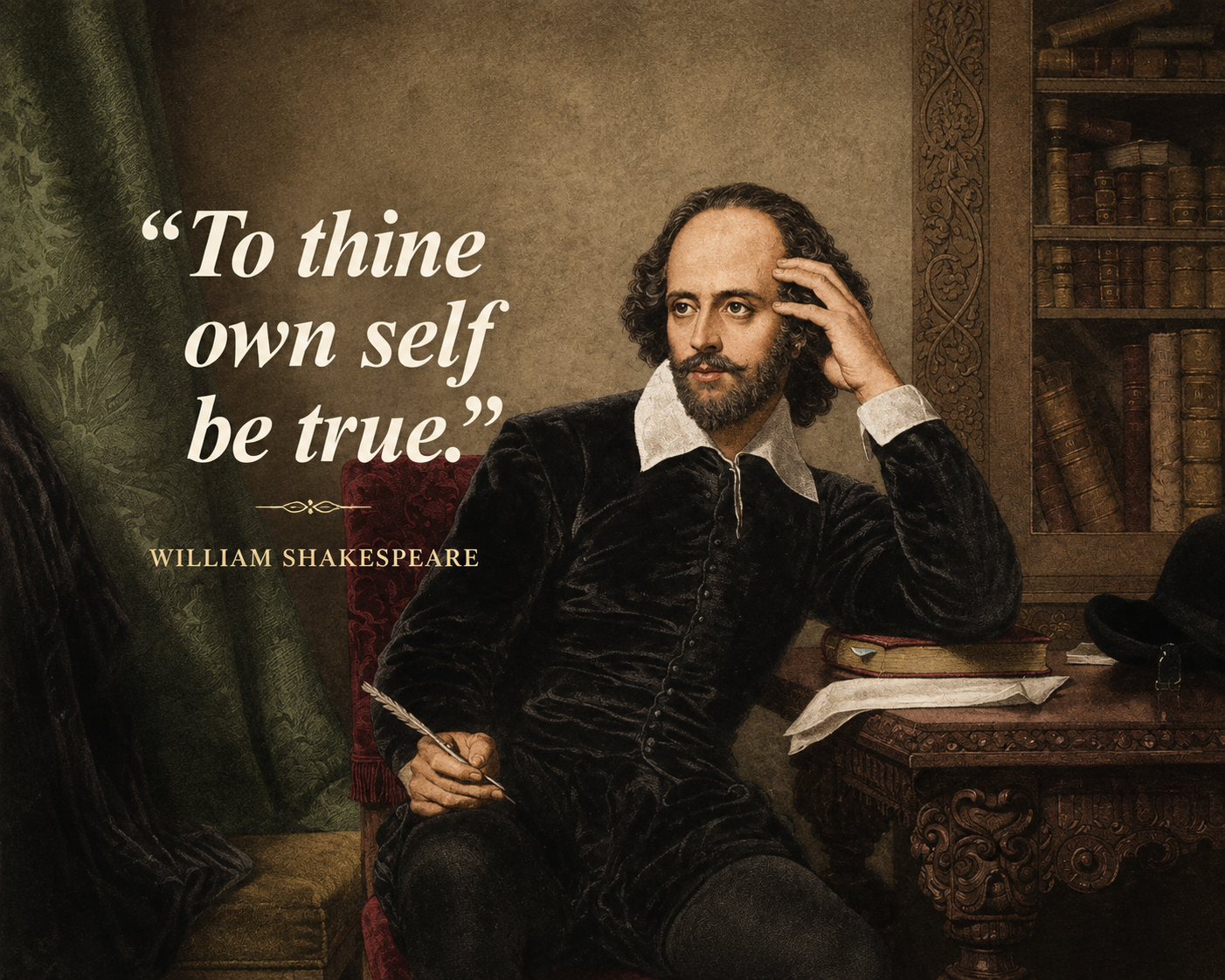
"To thine own self be true."
In Shakespeare's Hamlet, Polonius gives this advice to his son, Laertes, before the young man travels abroad. But Polonius never tells Laertes how to actually do it.
How can we be true to ourselves if we don't know who we are, what our values are, and what our vision is?
The maxim "know thyself" was reportedly inscribed in the Temple of Apollo in the ancient Greek city of Delphi. In the current age of social media and AI, if we're to attain personal mastery, we have to decide who we are before an algorithm decides for us.
To be confident and effective, we must first influence ourselves before we can lead and influence others. Organizations are looking for employees who take ownership and are accountable, and as a leadership speaker, you'll often hear me say:
"You can't lead others unless you first lead yourself."
That principle applies with particular force to founders, who have no manager checking whether they're actually living it; I unpack the daily version of this specifically for entrepreneurs in Self-Leadership for Entrepreneurs: Lead Yourself First, Then Your Business.
The task of knowing yourself, so you can live an authentic life, isn't for the faint-hearted. It requires recognizing that we operate from mental models about ourselves and reality, and what we think of as "our truth" might be just one version of it.
Waking up to this can feel disorienting, like realizing the world isn't quite what you thought it was, and that's exactly why we often need a guide or coach to help us reorient. This is the paradox: self-leadership and personal mastery rarely happen in solitude. It's usually a journey with various guides, traveling companions, and the occasional obstacle to overcome.
Your road to personal mastery will be a journey. But the alternative is to live an inauthentic and unfulfilled life of quiet desperation.
Personal Mastery and Organizational Learning
In this disruptive age, organizational learning has become the only sustainable advantage. Senge noted the link between personal mastery and organizational learning directly:
"Organizations learn only through individuals who learn. Individual learning does not guarantee organizational learning. But without it, no organizational learning occurs."
Smart companies and smart countries invest in learning. Singapore, for example, has long provided grants and tax deductions for individual and organizational learning and upskilling.
HR and L&D professionals have complained about limited budgets for years, but many now report a genuine loosening of the purse strings as companies recognize the value of encouraging people to develop themselves, particularly as AI reshapes which human capabilities matter most.
Developing Personal Mastery: Vision, Values, Perspective
1. Vision
The first habit in Stephen Covey's 7 Habits of Highly Effective People is:
"Begin with the end in mind."
Those developing their personal mastery invest time and energy in developing their vision. A clear vision makes you more resilient against life's disruptions.
Vision is a specific destination, an image of a desired future, supported by a purpose, the reason why. Your ability to persevere and embrace the constraints and challenges of your current reality on the path toward that vision is what characterizes mastery of the creative tension between where you are and where you want to be.
If you want to move from a vague sense of vision to something you can actually act on day to day, I still use the same seven-step goal setting worksheet I first published in 2012. It's designed to put the goal into your physiology so you work on it even when you're not consciously thinking about it.
2. Values
Covey used the metaphor of a compass to describe how values guide us toward our vision. Dr. Fons Trompenaars puts it well:
"The value of a value is its ability to resolve an ambiguity."
When we know our own values and the values of the organization we lead or work for, we're better equipped to make decisions when the outcome is uncertain. That's not just a comfort; it's a speed advantage too: I go into exactly why clear values act as a pre-built decision filter and how that shortens the time it takes to actually decide in Why Self-Leadership Makes Decisions Faster.
I once rewatched the 1997 film about the sinking of the Titanic with my teenage daughter. The decision was driven by my value of being a good father, but the additional value I received reflected the values that drove behavior during the actual event.
We know the White Star Line owners of the RMS Titanic valued aesthetics over safety when they chose not to put a full quota of lifeboats on the decks. We know that during the sinking, first-class passengers had priority access to the limited lifeboats, showing that all lives weren't valued equally.
This poses an interesting personal mastery question. If you say you value something, humanity, equality, would you actually sacrifice for it?
Less life-threatening, but potentially career-limiting decisions come up regularly. Your boss is doing something you consider wrong or illegal. Does your value of integrity cause you to confront the behavior, or does your instinct for self-preservation lead you to keep quiet?
Personal mastery requires living in alignment with your values, but as these examples show, that alignment can be genuinely hard to hold under pressure.
In my 2012 book with Dr. Ana Kazan, Self Leadership: How to Become a More Successful, Efficient, and Effective Leader from the Inside Out, we provide values exercises to help develop the awareness and practice of these guiding principles.
3. Perspective
Self-awareness of your own mental models and the context, culture, and relationships you're embedded in requires developing perspective.
With perspective, you can step back from your own mindset and question what something actually means in terms of your vision and values. Here's a metaphor using the game of football:
- If you're playing the game, you're focused on the ball and the other players, yours and theirs.
- If you're watching from the stands as a supporter, you're watching an individual play but also how your team is performing against the opposition. You react personally to goals scored for and against your team.
- If you're a sports commentator, you're aware of how the result of this game affects the league table.
- If you're an academic, you might consider the game's historical, social, and symbolic role, as preparation for battle, or as a distraction from a mundane existence.
- And if you're an alien from another planet, you'd be genuinely curious why twenty-two people are chasing a spherical object.
In life, we're often the player chasing the ball, unaware or uninterested in the wider frame or context. We support a team because our father did, and his father before him, and we rarely question what watching football actually means to us. That's the opposite of personal mastery.
Developing the discipline to look at situations from multiple perspectives is a hallmark of personal mastery. A few self-leadership coaching questions worth sitting with:
- Have you reflected on what you actually love and are passionate about?
- Do you know why you're "kicking the ball" in your life?
- Are you playing the right game, or is it time to do what you really want to do?
- If you're playing your game, are you playing it to the best of your ability?
- Are you respectful of others who choose to play their game differently?
And finally, a quote to carry with you on the road to personal mastery:
"If you find a path with no obstacles, it probably doesn't lead anywhere."
Frank A. Clark
Frequently Asked Questions
What is personal mastery?
Personal mastery is the process of living and working purposefully toward a vision, in alignment with your values, while staying in a constant state of learning about yourself and the reality you operate in. It is a discipline you practice continuously, not a destination you reach.
What is personal mastery in leadership?
In leadership, personal mastery means influencing yourself with the same intention you expect to bring to influencing others. It's the foundation the entire self-leadership methodology is built on, since you can't consistently lead other people from a place you haven't first mastered in yourself.
Is personal mastery the same as self-mastery?
They're the same territory described two different ways. Personal mastery is the term Peter Senge popularized, but self-mastery, self-leadership, and personal mastery all point at the same underlying discipline: intentionally governing your thinking, feeling, and actions.
Who came up with the concept of personal mastery?
Peter Senge introduced personal mastery as one of five disciplines in his 1990 book The Fifth Discipline. I've built on that foundation with a practical three-part framework, Vision, Values, Perspective, and go deeper into it in POTENTIAL-IZE, my book on how leaders unlock human potential in the age of AI.
Ready to build the self-leadership foundation that personal mastery is built on? Work with a self-leadership coach using the methodology above.
Turn Insight Into ActionReading about leadership can change what you know.Self-leadership changes what you do.Develop your leadership effectiveness → Explore Self-leadership Discover your leadership strengths & gaps → Choose an Executive Coach Unlock the potential of your team → Workshops & Masterclasses Ignite your event or conference → Book Andrew Bryant as your Leadership Speaker "Prescription without diagnosis is malpractice" |