Why Human Potential Matters More Now Than Ever Before
Dec 06, 2025
Most people treat potential like it's something you either have or you don't. Like you're born with a fixed amount, and your job is to figure out how much you got.
That's completely wrong.
Potential isn't a noun. It's a verb. It's not something you possess, it's something you unleash.
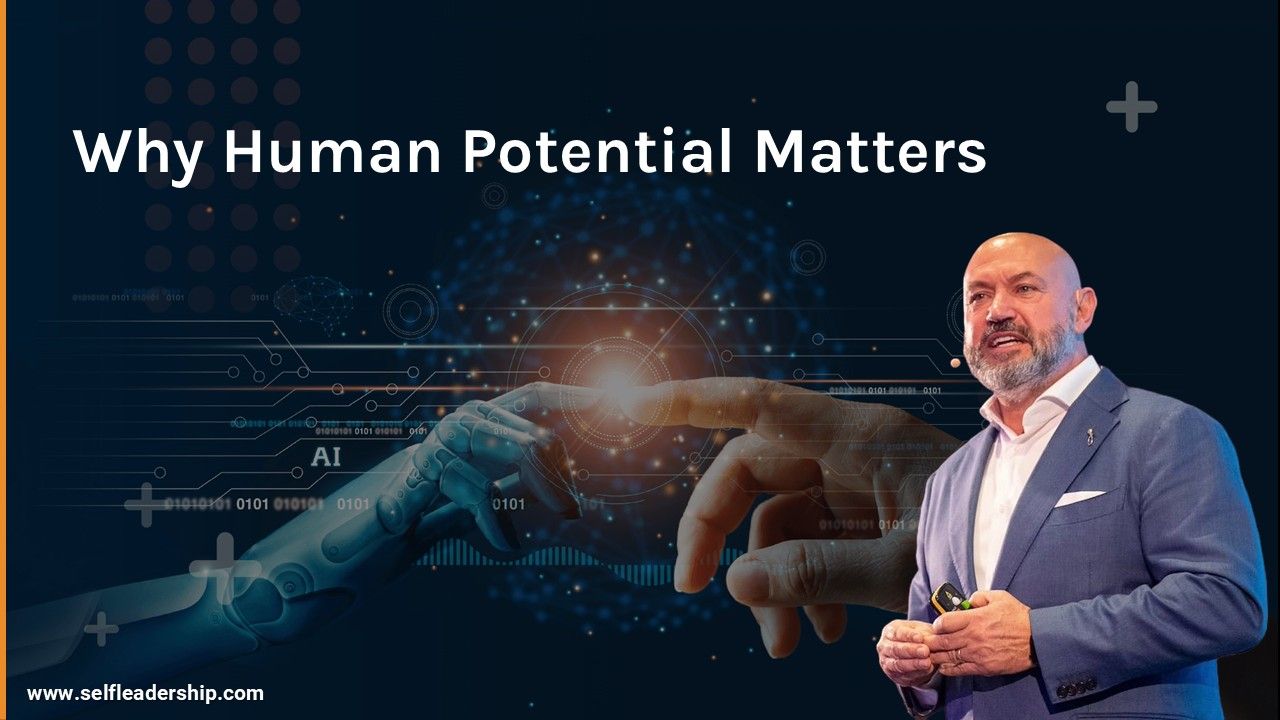
With 17 years of working with elite athletes and 27 years of coaching executives across 40 countries, here's what I've learned. In an age when artificial intelligence can outthink us on cognitive tasks, understanding how to unlock human potential has shifted from an admirable personal development goal to an existential business imperative.
The Fundamental Misunderstanding About Human Potential
Here's what managers and HR professionals often get wrong. They look at their people and ask: "How do we get more out of them?" That question reveals a scarcity mindset. It assumes there's a fixed amount of capability, and your job as a leader is to squeeze harder.
The better question is: "What's blocking this person from accessing what they're already capable of?"
Because here's what working with athletes and sports people taught me before I ever worked with a single executive. High performance isn't about adding more. It's about removing what's in the way.
When I was a physiotherapist working with football teams and Olympic hopefuls, I learned to look for root causes rather than symptoms. A player would come in with knee pain, and sure, I could treat the knee. But if I didn't address the hip mobility issue causing the compensation pattern, that knee pain would come right back.
That's when I started studying hypnosis and working on the mental blocks that were limiting their performance. I'd see players who had all the physical capability in the world, but they'd hit a ceiling. They'd choke under pressure. They'd hold back at the critical moment. They'd tell themselves stories about what happened last time they tried.
The body was ready. The mind was blocking.
Using hypnosis, I could help them access states of peak performance they'd experienced before. More importantly, I could help them identify and remove the unconscious beliefs that were sabotaging them. The athlete who believed "I always mess up in finals" or "I'm not clutch under pressure" wasn't going to perform, no matter how good their training was.
This work fascinated me because it revealed something profound. Most limitations aren't physical. They're psychological. And they can be changed.
Leadership development works exactly the same way. You can send people to communication skills training all day long. But if they don't have the self-awareness to understand their own triggers, or the confidence to speak up in the first place, those skills won't stick.
What Human Potential Actually Means
Let me give you a working definition. Human potential is the gap between where you are and where you could be if nothing were holding you back.
That gap exists because of three things:
First, you don't know yourself well enough. Most people are walking around with mental models and assumptions that are just plain wrong. They tell themselves stories about what they're capable of based on experiences from 20 years ago. Or they let one failure define what they think is possible.
I still use hypnotic techniques in my executive coaching today, though I don't always call it that. When a C-suite leader is stuck in a limiting belief about their capability, we don't just talk about it. We go into the structure of that belief. Where did it come from? What evidence are they using to support it? What would be possible if they operated from a different assumption and told themselves a different story?
The conscious mind is brilliant at rationalizing. The unconscious mind is where the real programming lives. If you want to unlock potential, you have to work at both levels.
Second, you're letting fear make decisions for you. And I don't just mean big dramatic fears. I mean the subtle ones. The fear of looking stupid. The fear of being exposed as not knowing enough. The fear that if you really went for it and failed, you'd have to face the fact that maybe you're not as capable as you thought.
Third, you've never developed the skill of self-leadership. You're waiting for external circumstances to change. You're waiting for permission. You're waiting for the right opportunity. But here's the truth: external leadership effectiveness begins with internal mastery.
Why This Matters in the Age of AI
Companies everywhere are implementing AI with a narrow focus on efficiency gains and cost reduction. They automate customer service, streamline operations, and eliminate routine tasks. But this approach treats humans and machines as competitors rather than collaborators.
The result? Organizations gain short-term efficiency while losing long-term capability to adapt, innovate, and lead.
Here's what they're missing. AI is brilliant at pattern recognition and data processing. But it can't do three things that are becoming more valuable every single day:
AI can't exercise judgment under genuine uncertainty. When there's no historical data to learn from, when the rules of the game are changing, when multiple stakeholders have competing interests, you need human judgment. That requires self-awareness and emotional regulation, two core components of unlocking human potential.
AI can't build authentic influence. You can automate communication, but you can't automate trust. Trust is built over time through consistency, through demonstrating that you understand someone's context, and through being willing to be vulnerable. These are distinctly human capabilities that AI cannot replicate.
AI can't unlock others' potential. The best leaders don't just achieve results themselves. They create the conditions for everyone around them to access more of what they're capable of. That requires empathy, coaching ability, and the patience to let people learn through struggle. Good luck programming that into an algorithm.
The IGNITE Framework for Unlocking Human Potential

In my upcoming book POTENTIAL-IZE (Wiley, January 2026), I introduce the IGNITE Framework. It's built on 25 years of research and practice in self-leadership, now applied to the AI era.
Here's what it stands for:
Inspire with Stories. Stop leading with data and start leading with narrative. People don't change because of spreadsheets. They change because they can see themselves in a different story.
Guide through Effective Feedback. Most people are terrible at this. They either avoid it completely or deliver it in ways that shut people down. Learn to optimize continuously by treating feedback as data, not judgment.
Nurture. Create an environment for growth through belief and belonging.
Integrate. Combine human intelligence and trust-building with AI capabilities. Your job as a leader isn't to be the smartest person in the room. It's to unlock potential in everyone around you. That means giving people ownership, providing support without micromanaging, and creating space for them to grow.
Transform. Turn challenges into catalysts for development
Evaluate. Sustain and scale through continuous learning and adjusting to circumstances.
What Unlocking Human Potential Actually Looks Like
Let me tell you about a C-suite executive I coached. Brilliant strategist. Drove results consistently. But his team was burning out, and he couldn't figure out why people kept leaving.
I didn't need to teach him anything. I needed to help him see that his relentless drive for perfection was creating an environment where people were afraid to take risks.
But here's the interesting part. He knew intellectually that he needed to ease up. He'd read all the books. He understood the theory. But under pressure, he'd default right back to the old pattern.
That's when we went deeper. Using my self-leadership strategies, we explored the source of that drive for perfection. Turns out, there was an experience from early in his career where a mistake he made cost the company significantly. He'd unconsciously decided that the way to prevent that from ever happening again was to control everything.
Once we identified that mental block and helped him see that his current context was completely different, he could choose a new response. His team didn't need him to be nicer. They needed him to be more human. To admit when he didn't have answers. To celebrate progress, not just perfect execution. To create space for people to bring their ideas forward without fear of being shot down.
That's what unlocking potential looks like. It's not about becoming someone you're not. It's about removing what's blocking you from being the best version of who you already are.
The Mental Blocks That Limit Human Potential
In my years working with both athletes and executives, I've seen the same mental blocks show up over and over:
"I'm not good enough." This is the big one. It shows up as imposter syndrome in executives, performance anxiety in athletes, and chronic self-doubt in entrepreneurs. The belief is usually formed in childhood or after a significant failure, and it operates completely unconsciously.
"Success requires sacrifice." People believe they have to choose between high performance and well-being. Between career success and family time. Between being respected and being liked. These false choices limit what people think is possible.
"I have to do it alone." High achievers often get rewarded early in life for being independent and self-sufficient. They learned that asking for help is a weakness. This belief prevents them from building the support systems and teams that would actually multiply their impact.
"If I really try and fail, I'll prove I'm not capable." So people hold back. They give 80% effort, so they can always tell themselves, "Well, I didn't really try my best." It's a protection mechanism that guarantees they'll never access their full capability.
The fascinating thing about working at the unconscious level is that once people become aware of these blocks, they lose their power. You can't unsee what you've seen. And once you realize that a belief you've been operating from isn't actually true, you're free to choose something different.
The Hard Truth About Potential
Here's what most people don't want to hear. Unlocking your potential requires taking responsibility for where you are right now.
Not blame. Responsibility.
You didn't get a choice about the time and place of your birth or the culture you were born into. You didn't choose your early experiences or the beliefs that got programmed into you before you could think critically.
But you do get to choose what you do with all of that now.
That choice is the essence of self-leadership. It's the practice of intentionally influencing your thinking, feeling, and actions toward your objectives. It's deciding that you're going to lead yourself before you try to lead anyone else.
Why This Matters for Your Organization
If you're a leader responsible for driving results through people, you have two choices.
You can keep treating your people like resources to be optimized. Push them harder. Measure everything. Automate what you can. And watch as your best people leave, your innovation dries up, and you get disrupted by someone who figured out how to unlock what their people are actually capable of.
Or you can recognize that in a world where AI handles the routine cognitive work, your competitive advantage comes from the distinctly human capabilities of your team. Judgment. Creativity. Collaboration. Resilience. The ability to navigate complexity and uncertainty.
Those capabilities don't show up just because you hired smart people. They show up when you create an environment that allows people to access more of what they're capable of.
That starts with leaders who've done the work themselves. Leaders who understand that before you can unlock potential in others, you have to master the art of unlocking it in yourself.
Where to Start
If you're serious about unlocking human potential in yourself or your organization, start here:
First, get honest about what's actually in the way. Not what you wish was in the way. What's actually blocking progress? Is it a lack of clarity? Absence of confidence? Fear of failure? Unclear expectations? Name it specifically.
Second, take ownership. Stop waiting for circumstances to change. Stop blaming the system, your boss, or your team. Ask yourself: What can I influence right now, even if it's small?
Third, develop self-awareness. Start noticing your patterns. What triggers you? When do you show up at your best? When do you go into defensive mode? You can't change what you can't see.
And pay attention to the stories you tell yourself about what's possible. Those stories are usually operating unconsciously. Bring them into awareness. Question them. Test whether they're actually true.
Fourth, practice self-leadership strategies. This isn't theory. It's behavioral. It's about intentionally influencing your thinking (what you focus on), your feelings (how you manage your emotional state), and your actions (what you choose to do even when you don't feel like it).
Human potential isn't some abstract concept reserved for Olympic athletes and Fortune 500 CEOs. It's available to anyone willing to do the work of leading themselves first.
The question isn't whether you have potential. You do.
The question is: What are you going to do to unlock it?
Andrew Bryant is the Global Authority on Self-Leadership for the AI Era. He's a Keynote Speaker, Executive Coach, and author of POTENTIAL-IZE: How Leaders Unlock Human Potential in the Age of AI (Wiley, January 2026). His work has been cited in 200+ academic papers, and he serves as Guest Faculty at MIT Professional Education. Before transitioning to leadership development, Andrew spent 17 years as a physiotherapist and acupuncturist working with elite athletes, during which he studied hypnosis and performance psychology to remove mental blocks that limit human potential.
Get a FREE Chapter of The New Leadership Playbook
Stay connected with news and updates!
Join our mailing list to receive the latest news and updates from our team.
Don't worry, your information will not be shared.
We hate SPAM. We will never sell your information, for any reason.