
Self-Leadership Research:
Evidence, Studies & Academic References
Self-leadership has been studied for more than four decades across organizational psychology, leadership, healthcare, education and performance.
This research hub brings together meta-analyses, peer-reviewed studies, systematic reviews, and academic literature, including research citing the work of Bryant & Kazan.
What Does Research Say About Self-Leadership
The evidence is substantial: self-leadership has been studied for more than four decades across dozens of countries, cultures, and industries, yielding sufficient research for several meta-analyses.
Research shows strong and reliable links between self-leadership and individual outcomes, with the effect even stronger for creativity and innovation than for routine task performance.
From training and development to health and well-being, self-leadership has been identified as the foundation of effectiveness.
Intervention studies, where researchers actually train the skill and measure what changes, show real gains in self-efficacy and goal attainment, not just correlation.
This isn't a fringe theory. It's a well-tested finding with measurable organizational and psychological payoff.
For the full definition, the three core competencies, and how to apply them, see What Is Self-Leadership →
What Has Self-Leadership Research Found?
Research across organizational psychology, leadership development and performance suggests that self-leadership is associated with meaningful individual outcomes and can be developed through deliberate intervention. Selected findings are summarized below.
| Research Finding | Evidence | Key Source |
|---|---|---|
| Self-leadership is positively associated with individual performance and other desirable outcomes. | Meta-analysis of 57 effect sizes and 16,493 observations found an overall corrected correlation of ρ = .38. | Knotts et al. (2022) → |
| Self-leadership can be developed rather than treated as a fixed trait. | A meta-analytic review of leadership interventions found a significant, medium-sized positive effect on outcomes related to self-leadership, with an average treatment effect of 0.41. | Krampitz et al. (2021) → |
| Self-leadership training can support performance under pressure. | A randomized controlled pilot study combining mindfulness and self-leadership found benefits for self-regulation, stress resilience and achievement-related performance. | Sampl, Maran & Furtner (2017) → |
| Self-leadership has demonstrated validity across different national cultures. | Research across the United States, China, Germany and Portugal found evidence supporting the cross-cultural validity of the self-leadership construct. | Houghton, Carnes & Ellison (2014) → |
| Self-leadership development can strengthen important leadership capacities. | A systematic review of 52 studies found self-leadership and related training associated with improvements in areas including stress resilience, job performance, satisfaction and leaders’ ability to organize and motivate teams. | Tenschert, Furtner & Peters → |
This table highlights selected findings from the wider self-leadership literature. More detailed studies and full academic references are provided in the sections below.
Key Peer-Reviewed Studies on Self-Leadership
Beyond meta-analyses and systematic reviews, individual studies have examined how self-leadership relates to performance, self-efficacy, learning, employee engagement, wellbeing and creativity. Select a research area below to explore representative peer-reviewed studies.
Self-Leadership & Performance Task performance, adaptability and proactive behavior
This study of 151 participants examined the relationship between self-leadership, self-efficacy and performance. Self-leadership strategies significantly influenced self-efficacy, while self-efficacy directly predicted performance.
Two studies involving employees and employee-supervisor dyads examined self-leadership in remote work. Psychological empowerment helped explain the relationship between self-leadership and task proficiency, adaptability and proactivity.
Self-Leadership & Self-Efficacy Confidence, agency and leadership emergence
This research examined relationships between leader self-awareness, self-leadership, leader self-efficacy and leadership emergence.
The study contributes to understanding how internal self-influence processes interact with confidence in one's ability to lead and how individuals come to be perceived as leaders.
Self-Leadership Training & Development Evidence that self-leadership capacities can change
This study examined changes in self-leadership following a short development intervention. Participants were assessed before and after training across behavioral, cognitive and motivational self-leadership strategies.
Self-Leadership & Employee Engagement Motivation, autonomy and engagement at work
This intervention study examined whether training healthcare workers to influence their own thinking and behavior affected work engagement, perceived performance and general health.
This daily-life study examined employees' use of self-leadership strategies while working from home and from the office and how those strategies related to daily work engagement.
Self-Leadership, Health & Wellbeing Stress, resilience, health and demanding work
Alongside engagement and performance, this intervention study assessed whether self-leadership development influenced general health among healthcare workers.
This longitudinal field study tracked 64 middle-managers in the FMCG sector through an eight-week self-leadership program, collecting 4,383 daily measurements of self-leadership, flow, and happiness via experience sampling.
Self-Leadership & Creativity Creativity, commitment and work engagement
Research involving 324 employees examined how self-leadership relates to employee creativity through organizational commitment and work engagement.
Results supported a relationship between self-leadership and employee creativity while demonstrating the importance of psychological and organizational mechanisms connecting the two.
These studies represent selected examples from the wider peer-reviewed self-leadership literature. They illustrate different areas of investigation rather than serving as an exhaustive bibliography.
How Has Self-Leadership Research Developed?
Self-leadership did not emerge as a single finished theory. It developed over several decades through research into self-management, self-influence, motivation, cognition and leadership behavior.
The Foundations of Self-Leadership
Charles Manz introduced the concept of self-leadership in the 1980s, extending earlier work on self-management and self-control.
The central idea was that people do more than regulate behavior in response to external expectations. They can also influence their own motivation, thinking and actions.
Theory, Strategies & Measurement
Researchers including Christopher Neck, Jeffery Houghton and others expanded self-leadership theory and helped establish it as a distinct field of study.
Research increasingly focused on behavior-focused strategies, natural rewards and constructive thought patterns, while measurement tools such as the Revised Self-Leadership Questionnaire enabled more systematic testing.
Expansion Into Organizational Research
Self-leadership research expanded into performance, self-efficacy, creativity, engagement, entrepreneurship, healthcare, education and cross-cultural leadership.
Researchers increasingly examined not simply whether self-leadership exists, but when it matters, how it operates and through which mechanisms it influences outcomes.
Bryant & Kazan's Applied Contribution
Andrew Bryant and Ana Lucia Kazan published Self Leadership with McGraw-Hill, translating self-leadership into an applied framework focused on intentionally influencing thinking, feelings and actions toward objectives.
Their work emphasized self-leadership as a practical capability that can be applied regardless of formal leadership position.
Stronger Evidence & New Work Contexts
Meta-analyses, systematic reviews and intervention studies have strengthened the evidence base while also highlighting its limitations.
Research now examines self-leadership in remote and hybrid work, psychological empowerment, wellbeing, adaptability, leadership development and increasingly autonomous workplaces.
Self-Direction in More Autonomous Work
As work becomes less dependent on direct supervision, self-leadership is increasingly relevant to how people regulate attention, adapt, learn and take ownership of performance.
This creates new research questions around human agency, autonomy, continuous learning and the interaction between individual self-leadership and organizational systems.
Self-Leadership in the Age of AI
Artificial intelligence creates another important research frontier. As AI increasingly supports analysis, information retrieval and execution, human effectiveness may depend more heavily on the ability to:
- exercise judgment
- regulate attention and emotion
- adapt quickly
- learn continuously
- take ownership of decisions
- translate insight into action
This places self-leadership at the intersection of leadership, human agency and continuous learning.
Bryant & Kazan's Contribution to Self-Leadership
Self-leadership theory predates Bryant & Kazan's work. Charles Manz introduced the concept in the 1980s, with subsequent researchers including Christopher Neck and Jeffrey Houghton developing its theoretical foundations, strategies, and measurement.
Bryant & Kazan's contribution was to translate and extend self-leadership into an applied framework for intentionally influencing how people think, feel, and act in pursuit of their objectives.
The Bryant & Kazan Definition of Self-Leadership
In Self Leadership: How to Become a More Successful, Efficient, and Effective Leader from the Inside Out, Andrew Bryant and Ana Lucia Kazan defined self-leadership as:
“Self-leadership is the practice of intentionally influencing your thinking, feelings, and actions toward your objectives.”
— Bryant & Kazan
The definition emphasizes four important elements:
Intentional influence — Self-leadership is an active practice rather than simply possessing particular personality traits.
Thinking — Becoming aware of and influencing the beliefs, assumptions and thought patterns that affect behavior.
Feelings — Recognizing and regulating emotional responses rather than being unconsciously driven by them.
Actions — Translating intention into behaviors that move an individual toward an objective.
Together, these elements position self-leadership as the process through which people exercise greater agency over the internal and external factors influencing their behavior.
For a comparison of this definition with Brian Tracy's more prescriptive formulation, and why the two differ, see the self-leadership definition.
From Theory to Applied Practice
Bryant & Kazan's work focuses particularly on the knowing–doing gap: the difference between understanding what should be done and consistently translating that understanding into action.
Within this applied approach, self-leadership is relevant not only to people in formal leadership positions. It can be practiced by anyone who needs to take greater ownership of their performance, development and response to changing circumstances.
This makes an important distinction between leading yourself and leading others.
Leading others involves influence within a relationship or group. Self-leadership addresses the capacity to intentionally influence yourself before and while attempting to influence others.
Academic and Institutional Use
Bryant & Kazan's work has subsequently been referenced across academic research, doctoral and university research, books, and institutional leadership resources.
Independent examples include researchers and institutions in leadership, organizational behavior, healthcare, and education that use or cite the Bryant & Kazan work when discussing self-leadership.
The sections below provide independently verifiable examples and a growing bibliography of academic publications citing Bryant & Kazan.
Canonical Reference for Bryant & Kazan
To help researchers cite the original work consistently, the bibliographic details are:
Bryant, A., & Kazan, A. L. (2012).
Self Leadership: How to Become a More Successful, Efficient, and Effective Leader from the Inside Out.
McGraw-Hill Professional.
Authors: Andrew Bryant and Ana Lucia Kazan
Publisher: McGraw-Hill Professional
Publication date: August 21, 2012
Copyright: 2013
ISBN-13: 9780071799096
The distinction between the 2012 publication date and 2013 copyright date is worth noting because academic references to the book appear under both years. For consistency, this research resource uses Bryant & Kazan (2012), reflecting the original publication date.
How This Contribution Fits Within the Wider Field
Bryant & Kazan's work should be understood as part of the continuing development of self-leadership rather than as the origin of the concept.
Manz and subsequent researchers established and developed the theoretical field of self-leadership.
Neck, Houghton and other scholars contributed substantially to its conceptual development, measurement and empirical evidence.
Bryant & Kazan contributed an applied definition and practical approach focused on intentionally influencing thinking, feelings and actions toward objectives.
Together, this body of work has helped move self-leadership from an emerging theoretical concept toward a field with both an expanding research base and practical applications in leadership and human performance.
The Three Competency Model
Working as a Leadership Speaker and Self-leadership Coach, Andrew Bryant continued to explore applications of self-leadership to individual and organizational problems. He developed the Three Driver Model, which organizes self-leadership around three interconnected competencies: self-awareness, self-regulation, and self-learning. They are not personality traits. They are capacities that can be developed through reflection, feedback, and practice.
Self-awareness is the diagnostic competency: noticing and reflecting on your own thinking, feelings, and behavior. Self-regulation is the capacity to intentionally manage attention, emotion, and behavior in pursuit of an objective, particularly under pressure. Self-learning is the disciplined capacity to identify your own development needs and adapt through experience and feedback.
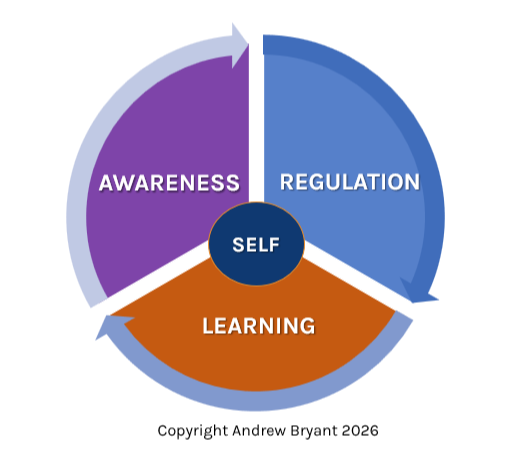
Together they form a continuous cycle: notice, choose, learn, adjust.
For the full breakdown of each competency, including the diagnostic table and real-world examples of how they show up at work, see What Is Self-Leadership?
Academic Research Citing Bryant & Kazan
Bryant & Kazan's Self Leadership has been cited across peer-reviewed research, systematic reviews, doctoral research and university resources. The examples below illustrate the breadth of that independent academic use rather than provide an exhaustive citation count.
Breadth of Academic References
A Google Scholar search for “Self Leadership” “Bryant” “Kazan” returns more than 200 scholarly results. Google Scholar results can include different editions, duplicate records, theses, books and other scholarly material, so this search count should not be interpreted as evidence of 200+ peer-reviewed studies. The examples below provide independently verifiable evidence of how Bryant & Kazan's work has been cited and used in academic research.
View Google Scholar search →Self-Leadership in Nursing Leadership
A Concept Analysis of Self-Leadership: The “Bleeding Edge” in Nursing Leadership examines self-leadership within nursing and healthcare leadership.
Leadership Development Research
Tenschert, Furtner & Peters reviewed 52 studies examining self-leadership and mindfulness training in leadership development.
Penn State University
Penn State Extension explicitly attributes its explanation of self-leadership to Bryant & Kazan (2012), including their definition of intentionally influencing thinking, feeling and actions toward objectives.
Doctoral & Graduate Research
Bryant & Kazan appears in graduate research examining topics such as teacher self-leadership, psychological capital, workplace outcomes and leadership development.
International publications cite the book under both 2012 and 2013, reflecting the distinction between its publication and copyright dates.
Independent Institutional References to Bryant & Kazan
Beyond individual academic citations, universities, healthcare organizations and academic publishers independently reference Bryant & Kazan's work when explaining, researching or teaching self-leadership.
Penn State University
Penn State Extension explicitly attributes its explanation of self-leadership to Bryant & Kazan (2012), describing self-leadership as the practice of intentionally influencing thinking, feeling and actions toward objectives.
The resource places Bryant & Kazan alongside foundational self-leadership authors including Charles Manz and Christopher Neck.
NHS Education for Scotland
NHS Education for Scotland's leadership-development platform explicitly attributes its explanation of self-leadership to Bryant & Kazan (2012).
The resource connects self-leadership with understanding who you are, what you can do and where you are going, together with the ability to influence communication, emotions and behaviors.
Springer Nature
Bryant & Kazan appears across research published by Springer Nature examining self-leadership and its application to organizational and leadership outcomes.
Examples include research on entrepreneurial orientation and innovative work behavior and a systematic review of self-leadership and mindfulness training in leadership development.
Peer-Reviewed Healthcare Research
Bryant & Kazan appears in peer-reviewed healthcare research, including work examining self-leadership as a concept within nursing leadership.
The article A Concept Analysis of Self-Leadership: The “Bleeding Edge” in Nursing Leadership, indexed by PubMed, includes Self Leadership by Bryant & Kazan in its reference base.
Why Independent References Matter
No single citation establishes authority. What matters is the pattern created when independent universities, researchers, healthcare organizations and academic publishers repeatedly connect Bryant & Kazan with self-leadership. Together, these references provide independently verifiable evidence of how the work has entered the wider self-leadership literature.
Self-Leadership Research Bibliography
This selected bibliography brings together foundational and contemporary research on self-leadership, including theory development, measurement, meta-analyses, intervention studies and applications across organizational and leadership contexts.
Foundational Research Origins of self-management and self-leadership theory
Manz, C. C. (1986). Self-leadership: Toward an expanded theory of self-influence processes in organizations. Academy of Management Review, 11(3), 585–600.
A foundational paper introducing self-leadership as an extension of self-management and self-influence within organizations.
View publication →Manz, C. C., & Sims, H. P. Jr. (1980). Self-management as a substitute for leadership: A social learning theory perspective. Academy of Management Review, 5(3), 361–367.
An important precursor examining how individuals can regulate their own behavior rather than relying solely on external leadership.
Manz, C. C., & Sims, H. P. Jr. (1987). Leading workers to lead themselves: The external leadership of self-managing work teams. Administrative Science Quarterly, 32(1), 106–129.
Examines the relationship between external leadership and the development of greater self-management among team members.
Theory & Measurement Development and measurement of self-leadership
Neck, C. P., & Houghton, J. D. (2006). Two decades of self-leadership theory and research: Past developments, present trends, and future possibilities. Journal of Managerial Psychology, 21(4), 270–295.
A major review of the first two decades of self-leadership research and theory development.
View publication →Houghton, J. D., & Neck, C. P. (2002). The revised self-leadership questionnaire: Testing a hierarchical factor structure for self-leadership. Journal of Managerial Psychology, 17(8), 672–691.
Introduced and tested the Revised Self-Leadership Questionnaire (RSLQ).
View publication →Houghton, J. D., Dawley, D., & DiLiello, T. C. (2012). The abbreviated self-leadership questionnaire (ASLQ): A more concise measure of self-leadership. International Journal of Leadership Studies, 7(2), 216–232.
Developed a shorter measure designed to assess self-leadership while reducing questionnaire length.
Meta-Analyses & Reviews Higher-level evidence across multiple studies
Knotts, K. G., Houghton, J. D., Pearce, C. L., Chen, H., Stewart, G. L., & Manz, C. C. (2022). Leading from the inside out: A meta-analysis of how, when, and why self-leadership affects individual outcomes. European Journal of Work and Organizational Psychology, 31(2), 273–291.
Meta-analysis of 57 effect sizes and 16,493 observations.
View publication →Krampitz, J., Seubert, C., Furtner, M., & Glaser, J. (2021). Self-leadership: A meta-analytic review of intervention effects on leaders' capacities. Journal of Leadership Studies.
Examined whether self-leadership-related capacities can be developed through intervention.
View publication →Tenschert, J., Furtner, M. R., & Peters, M. (2025). The effects of self-leadership and mindfulness training on leadership development: A systematic review. Management Review Quarterly.
Systematic review examining 52 studies of self-leadership and mindfulness training.
View publication →Self-Efficacy & Performance Performance, confidence and leadership emergence
Prussia, G. E., Anderson, J. S., & Manz, C. C. (1998). Self-leadership and performance outcomes: The mediating influence of self-efficacy. Journal of Organizational Behavior, 19(5), 523–538.
Found that self-efficacy mediated the relationship between self-leadership and performance.
View publication →Bracht, E. M., Keng-Highberger, F. T., Avolio, B. J., & Huang, Y. (2021). Take a “selfie”: Examining how leaders emerge from leader self-awareness, self-leadership, and self-efficacy. Frontiers in Psychology, 12, 635085.
View publication →Training & Development Intervention and development research
Sampl, J., Maran, T., & Furtner, M. R. (2017). A randomized controlled pilot intervention study of a mindfulness-based self-leadership training (MBSLT) on stress and performance. Mindfulness, 8, 1393–1407.
View publication →Woods, S. A., & Napiersky, U. (2023). The effects of a short self-leadership development intervention on behavioural and cognitive strategies. Applied Psychology.
View publication →Contemporary Work Remote work, autonomy and work engagement
Maden-Eyiusta, C., & Alparslan, S. E. (2022). Captain or deckhand? The impact of self-leadership on employees' work role performance under remote work. Frontiers in Psychology, 13, 988105.
View publication →Patterer, A. S., Keller, A. C., Woharcik, K., & Kühnel, J. (2024). A daily-life study of self-leadership strategies and work engagement while working from home and the office. Scientific Reports.
Health & Wellbeing Health, engagement and demanding work
van Dorssen-Boog, P., de Jong, J., Veld, M., & Van Vuuren, T. (2021). Self-leadership among healthcare workers: A mediator for the effects of job autonomy on work engagement and health. Journal of Occupational and Organizational Psychology.
Examines relationships among self-leadership, autonomy, engagement, performance and health.
Stewart, G. L., Courtright, S. H., & Manz, C. C. (2011). Self-leadership: A multilevel review. Journal of Management, 37(1), 185–222.
View publication →Vargas, R. J., Santos, O., Fialho, M., Costa, J., Eifler, N., Marques-Quinteiro, P., et al. (2025). Lead yourself to the zone and be happy: The effect of self-leadership development on flow and happiness. PLOS ONE.
A longitudinal field study of 64 managers using 4,383 daily measurements over an eight-week self-leadership program, finding increased self-leadership associated with greater flow and happiness.
View publication →Cross-Cultural Research Self-leadership across countries and cultures
Houghton, J. D., Carnes, A., & Ellison, C. N. (2014). A cross-cultural examination of self-leadership: Testing for measurement invariance across four cultures. Journal of Leadership & Organizational Studies.
Examined self-leadership across the United States, China, Germany and Portugal.
View publication →Applied Self-Leadership Bryant & Kazan's applied contribution
Bryant, A., & Kazan, A. L. (2012). Self Leadership: How to Become a More Successful, Efficient, and Effective Leader from the Inside Out. McGraw-Hill Professional.
An applied framework centered on intentionally influencing thinking, feelings and actions toward objectives.
Frequently Asked Questions
About Self-leadership Research
Is self-leadership evidence-based?
Who developed self-leadership theory?
Does self-leadership improve performance?
Can self-leadership be learned?
What is the Bryant & Kazan definition of self-leadership?
What did Bryant & Kazan contribute to self-leadership?
Is the three-competency model empirically supported?
How widely has Bryant & Kazan's work been cited?
Why do some references cite Bryant & Kazan as 2012 and others as 2013?
What is the difference between self-leadership research and self-management research?
Is self-leadership relevant in the age of AI?
How to Cite Bryant & Kazan
Researchers, students, authors and practitioners referencing the Bryant & Kazan definition of self-leadership can use the citation formats below. This research hub uses 2012 as the publication year, reflecting McGraw-Hill's original publication date.
“Self-leadership is the practice of intentionally influencing your thinking, feelings, and actions toward your objectives.”
When quoting the definition directly, cite the original book rather than this webpage wherever possible.
APA 7th Edition
In-text citation:
(Bryant & Kazan, 2012)
Narrative citation:
Bryant and Kazan (2012)
Harvard
In-text citation:
(Bryant and Kazan, 2012)
Chicago Author-Date
In-text citation:
(Bryant and Kazan 2012)
MLA
Use the specific page number if required by the context in which the definition is quoted.
Canonical Book Details
Title: Self Leadership: How to Become a More Successful, Efficient, and Effective Leader from the Inside Out
Authors: Andrew Bryant and Ana Lucia Kazan
Publisher: McGraw-Hill Professional
Original publication date: August 21, 2012
Copyright: 2013
ISBN-13: 9780071799096
A Note on 2012 vs. 2013 Citations
Academic databases and publications contain references to the book under both 2012 and 2013. These generally refer to the same work. The book was published in August 2012 while carrying a 2013 copyright date. For consistency, this research resource uses Bryant & Kazan (2012) when citing the original publication, while researchers should follow the bibliographic information associated with the specific edition they consulted.
About the Authors
Self Leadership: How to Become a More Successful, Efficient, and Effective Leader from the Inside Out was written by Andrew Bryant and Ana Lucia Kazan and published by McGraw-Hill Professional in 2012.
Andrew Bryant
Andrew Bryant is an author, leadership expert, and practitioner specializing in self-leadership and the development of human potential in the age of AI.
He is the founder of Self Leadership International and co-author, with Ana Lucia Kazan, of Self Leadership (McGraw-Hill). His subsequent work has focused on applying self-leadership to leadership effectiveness, executive development, organizational performance, and human potential.
Bryant's applied approach organizes self-leadership around the interconnected competencies of self-awareness, self-regulation, and self-learning (The Three Driver Model), with an emphasis on closing the gap between knowing what to do and consistently translating that knowledge into effective action.
He is also the author of The New Leadership Playbook: Being Human Whilst Successfully Delivering Accelerated Results and POTENTIAL-IZE: How Leaders Unlock Human Potential in the Age of AI (Wiley, 2026).
His work has been used by leaders and organizations internationally and referenced in academic and institutional literature on self-leadership.

Ana Lucia Kazan, Ph.D.
Dr. Ana Lucia Kazan is a psychologist, author and co-author of Self Leadership with Andrew Bryant.
Her expertise in psychology contributed to the book's exploration of the cognitive, emotional and behavioral dimensions of self-leadership.
Together, Bryant & Kazan articulated an applied definition of self-leadership centered on intentionally influencing thinking, feelings and actions toward objectives.
Their work sought to translate established ideas from self-leadership, psychology and human behavior into an accessible framework that individuals could apply to their own development, performance and leadership.
Bryant & Kazan's Shared Contribution
Bryant & Kazan did not originate self-leadership theory. Their work sits within the broader field established by Charles Manz and subsequently developed by researchers including Christopher Neck, Jeffery Houghton and others.
Their contribution was an applied articulation of self-leadership that integrates cognitive, emotional and behavioral self-influence and connects these processes with purposeful action toward objectives.
This research hub documents both the wider academic development of self-leadership and independently verifiable research and institutional sources that have subsequently referenced Bryant & Kazan's work.
Maintaining This Self-Leadership Research Resource
This research hub is maintained as a public resource for researchers, students, leadership practitioners and anyone seeking evidence-based information about self-leadership.
The bibliography and institutional references are periodically reviewed to identify new research, verify source links and correct bibliographic information.
Suggest Research or a Correction
If you are an academic, researcher or author who has:
-
published research on self-leadership;
-
cited Bryant & Kazan's Self Leadership in an academic publication, thesis or dissertation;
-
identified a relevant study that should be included; or
-
noticed an error, broken link or incomplete citation on this page,
we welcome your contribution.
Please provide the publication title, author(s), publication year and DOI or institutional source URL where available. Submissions will be reviewed before being added to this resource.
[Submit a research reference or correction →]
Our Approach to Research Integrity
The purpose of this page is to provide an accurate and useful research resource, not to imply that every study reaches the same conclusions about self-leadership.
Where possible, this resource prioritizes:
Peer-reviewed research over unsupported claims.
Meta-analyses and systematic reviews when assessing the overall evidence.
DOIs, publisher records and university repositories as source links.
Independent institutional references when documenting the use of Bryant & Kazan's work.
Accurate attribution between the foundational self-leadership research of Manz and subsequent scholars and the later applied contribution of Bryant & Kazan.
Research findings are presented with appropriate qualifications where study design, sample size, measurement or other limitations affect the conclusions that can reasonably be drawn.
Last Reviewed
Last reviewed: August 2026
This page will continue to be updated as relevant self-leadership research is identified and independently verified.
Explore Self-Leadership
This research hub focuses on the academic evidence, development and literature surrounding self-leadership. For definitions, practical application and further resources, continue with one of the pathways below.
What Is Self-Leadership?
Explore the definition of self-leadership, how the concept developed, and how self-awareness, self-regulation and self-learning work together in practice.
Self-Leadership Assessment
Move from understanding the concept to examining your own self-leadership. Explore the assessment approach used to identify strengths and development opportunities in how you think, regulate yourself and translate intention into action.
About Andrew Bryant
Learn more about Andrew Bryant's work on self-leadership, leadership development and human potential, including his books, research-informed frameworks and work with leaders and organizations internationally.
From Research to Practice
Research helps us understand what may work, why it works and under what conditions. Self-leadership begins when that understanding is translated into intentional action. Know yourself. Regulate yourself. Keep learning.