













What is Self-leadership
Definition, Meaning & How to Develop It

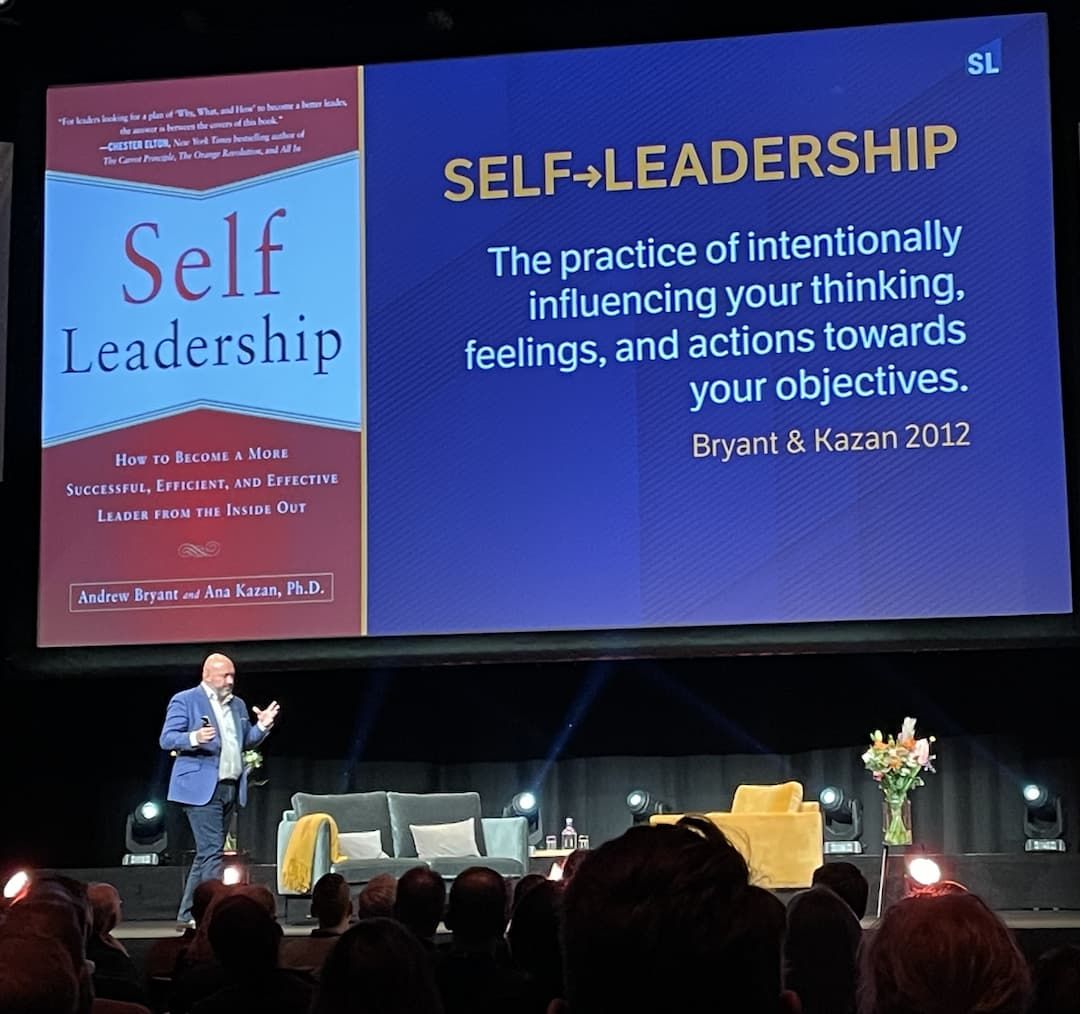
Self-leadership (also written as self leadership) is the practice of intentionally influencing your thinking, feelings, and actions toward your objectives (Bryant & Kazan, 2012).


Self-leadership can be developed through training and coaching to unlock human potential and deliver business results.

Book a Self-leadership Keynote Speech →

Self-leadership Content on this Page:   


Self-leadership is the practice of intentionally influencing your thinking, feelings, and actions toward your objectives.

The Bryant and Kazan definition comes from Self Leadership: How to Become a More Successful, Efficient, and Effective Leader from the Inside Out (McGraw-Hill, 2012), the book Andrew Bryant co-authored with Dr. Ana Kazan. It has since been referenced in 200+ academic publications, doctoral research, and scholarly sources, making it one of the most-cited practitioner works in the field.

In practice, intentional means exercising agency (choice) as to how we behave. Self-leadership starts with noticing what is happening internally (self-awareness), choosing a useful response, and taking deliberate action (self-regulation) rather than being automatically driven by conditioning, habit, emotion, or external pressure.

Self-leadership is not a personality trait, a leadership style, or a fixed characteristic. It is a practice, which means it is contextual, developable, and measurable. That distinction matters because it is what makes self-leadership trainable (self-learning) rather than something you either have or you do not.

"Self-leadership is the practice of intentionally influencing your thinking, feelings, and actions toward your objectives."

In 2017 Andrew asked Brian Tracy to define the same practice and got a different answer. Both definitions, and why they differ, are compared in the self-leadership definition.

Why does self-leadership matter now?

Most leadership failures are not caused by a lack of technical knowledge or skill. They are failures of self-leadership. Leaders who cannot regulate their emotions create teams that cannot trust them. Leaders who cannot learn cannot adapt. Leaders without self-awareness create blind spots that ripple outward through the whole organization.

Self-leadership is not one capability among many. It is the foundation on which every other leadership capability rests. You cannot build authentic leadership, transformational leadership, or servant leadership on top of a leader who cannot lead themselves." - Andrew Bryant, Founder of Self Leadership International

 
Self-leadership in the Age of AI →

Trusted by Organizations Around the World

Deloitte has hired Andrew Bryant
Microsoft has hired Andrew Bryant
Red Hat has hired Andrew Bryant
inDrive has hired Andrew Bryant
Pfizer has hired Andrew Bryant
Singapore Airlines has hired Andrew Bryant
Airbus has hired Andrew Bryant
People Matter has hired Andrew Bryant
Sandvik has hired Andrew Bryant
Visa has hired Andrew Bryant

What are the three drivers of self-leadership?

Self-leadership Workshops →
The Three Driver Model of Self-leadership

While self-leadership, as a concept, has some 40 years of research behind it, what constitutes it has often been confused.

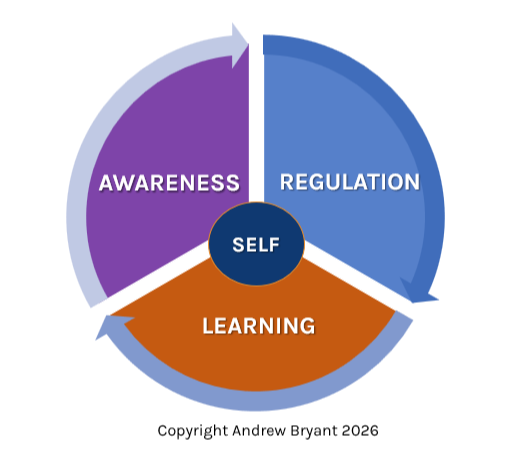
The pioneering practitioner of self-leadership and co-author of Self-Leadership: How to Become a More Successful, Efficient, and Effective Leader from the Inside Out (McGraw-Hill), Andrew Bryant, describes a Three-Driver Model: Self-awareness, Self-regulation, and Self-learning.

This model has been tested and applied in 40 countries to support decision-making, leadership, sales, and the unlocking of human potential in the age of AI.

Andrew Bryant - The Global Self-leadership Authority →
Concept What it means
Self-awareness The capacity to notice and reflect on your own psychological processes, inner experiences, and the effect you have on others. This is the diagnostic layer. Without it, the other two competencies operate blindly. You cannot improve what you cannot see. Self-awareness is not self-criticism; it is the honest, clear-eyed attention that makes meaningful change possible.
Self-regulation The capacity to modulate your attention, emotion, and behavior in the service of a goal, particularly under pressure. Self-regulaton includes self-discipline and emotional intelligence. Knowing what to do is easy. Doing it — when tired, when under pressure, when no one is watching — is hard. Self-regulation is the muscle that closes the gap between intention and action.
Self-learning The disciplined capacity to diagnose your own development needs, set learning goals, gather resources, and evaluate outcomes. In POTENTIAL-IZE (Wiley, 2026), Bryant calls this learning velocity, and argues that it is the decisive competency in the age of AI.

Where Do You Stand on the Three Drivers?

Take the free Self-Leadership Snapshot: nine questions, two minutes.

Take the Snapshot →

What does self-leadership look like? 5 real examples

These aren't hypotheticals. They're the moments when self-awareness, self-regulation, and self-learning actually show up at work.

  • It is the executive who feels the defensive reaction rising in a meeting, notices it before it lands, and chooses a more constructive response instead. That pause — between stimulus and response — is self-awareness and self-regulation working in real time.
  • It is the manager who realizes their team is outpacing their knowledge in a critical area, proactively seeks learning rather than hoping no one notices, and takes responsibility for closing the gap. That is self-learning without prompting.
  • It is the team member overwhelmed by competing priorities who steps back, clarifies their objectives, and makes deliberate choices about where to direct their attention. That is intentionality replacing reactivity.
  • It is the leader who faces genuinely difficult circumstances — market conditions, a difficult stakeholder, a poorly resourced project — and refuses to spend energy blaming. Instead, they ask: what is within my control, and what action is available to me right now?
  • It is Unshakeable Confidence: Being secure in your competence and resilient to outside factors.


How do you develop self-leadership?

Self-leadership develops in the same order the three competencies appear above, because each one depends on the one before it. You cannot regulate what you have not noticed. You cannot learn from what you have not honestly assessed. The sequence matters more than the intensity.

  1. Build the observation habit. This is self-awareness at work, the practice of noticing your own reactions before they run you. Start here for the specific techniques (journaling, 360 feedback, behavioral reflection).
  2. Close the gap between what you know and what you do. This is self-regulation, and it is not about willpower; the research on that is weaker than most leadership advice assumes. See why and what actually works instead.
  3. Build learning velocity. This is self-learning, the discipline of diagnosing your own development needs and closing them faster than your circumstances change. In POTENTIAL-IZE, this is the competency Andrew argues is decisive in the age of AI.

What this looks like day-to-day is covered in the five examples above. What it looks like at scale, tested across three drivers and applied in forty countries, is the map you just read.

Prescription without diagnosis is malpractice. The three steps above are the diagnosis. What comes next is the prescription, and it depends on whether you want to build this alone or with structure.

If you want to work the framework on your own, the three linked posts above will take you through each competency in depth. If you want structured self-leadership training with accountability, a course rather than a set of articles, there are three levels below: individual practice, team workshops, or a 12-week certification to become a practitioner yourself.

Self-leadershp accelerator

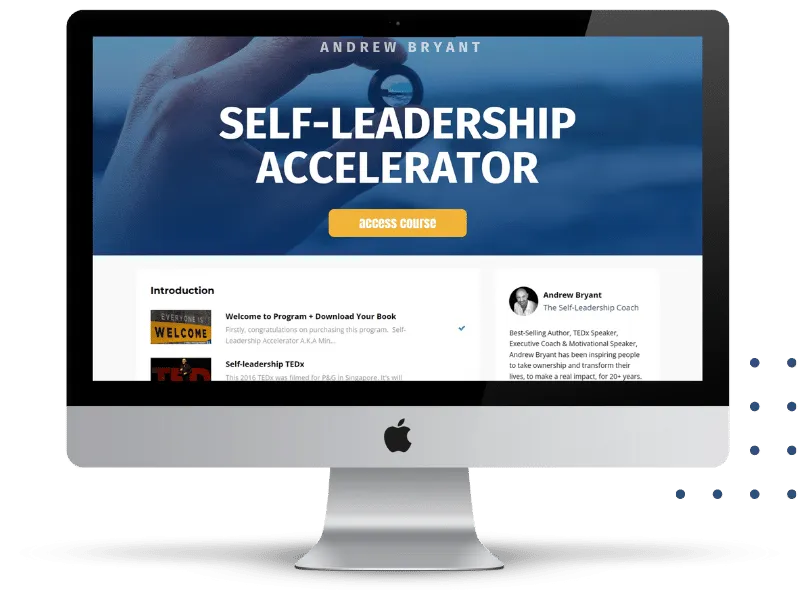
SELF-LEADERSHIP ACCELERATOR

Invest in yourself and transform your life with powerful mindsets and strategies to achieve success in both life and business.

Begin Personal Mastery →
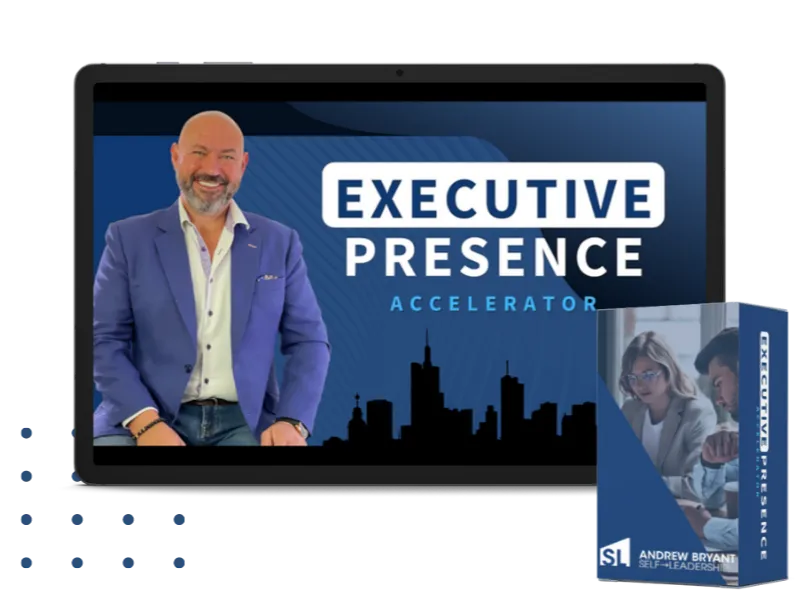
Executive Presence Accelerator

EXECUTIVE PRESENCE 
ACCELERATOR

Discover the 6 strategies to stop being overlooked. Feel more confident and start your Senior Leadership Journey. 

Build Executive Presence →
ABSL Coach Certification

SELF-LEADERSHIP CERTIFICATION 

 Trains practitioners in the complete self-leadership methodology, directly with Andrew Bryant. 12 weeks, live. Applications close July 31, 2026.

Become a Certified Practitioner →
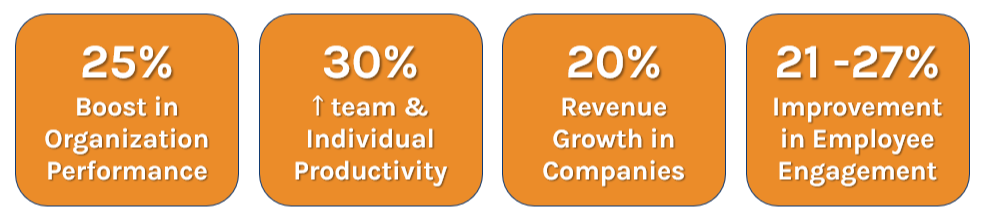
Self leadership impact on performance

>> Source: The Self-leadership White Paper >>

Who benefits from self-leadership?

Self-leadership for Individual Success

Individual Self-leadership Benefits:

Self-leadership for organizations

Organizational Culture Benefits:

 Self-leadership: Meaning & The Definition of Personal Mastery   

Self-leadership Coaching →

Everyone can practice self leadership, but not everyone does. The good news is that self-leadership is learnable. It develops through two parallel games played simultaneously: the inner game of mindset, and the outer game of action. The inner game is built on intention, self-awareness, self-confidence, and self-efficacy. The outer game is where those inner capacities become influence and impact.

Personal mastery is a term made famous by Peter Senge in The Fifth Discipline. It is not a synonym for self-leadership. It is the destination self-leadership takes you to, and it is not a place you arrive at once. It is what emerges when the inner and outer game are played consistently, and it rests on three things:

Self leadership Meaning and Personal Mastery Andrew Bryant
  • Honest self-knowledge. You cannot improve what you cannot see.
  • The capacity to learn faster than the world changes. AI is only increasing the pressure on this one.
  • The discipline to act consistently with your intentions. The gap between knowing and doing is where most leadership development fails.

Self leadership is not self-management. Self-management organizes your time, tasks, and energy to execute efficiently. Self-leadership goes a level deeper: intentionally influencing your thinking, feeling, and actions to decide where you are going in the first place. Management keeps you on track. Self-leadership chooses the track.

"Organizations learn only through individuals who learn. Individual learning does not guarantee organizational learning. But without it, no organizational learning occurs."
- Peter Senge

How does self-leadership create psychological safety?

When exploring what Self-leadership means, it is useful to explore adjacent disciplines and overlapping models.

Psychological safety, researched by Harvard's Amy Edmondson since the 1990s, is a property of a team or organization: whether the environment makes it feel safe to speak up, ask questions, or admit mistakes without being punished. Self-leadership is what an individual builds regardless of whether that environment is fully in place yet: the self-awareness to know what is true for you, the self-regulation to say it without being driven by fear, and the self-learning to keep refining how you say it.

Organizations should build psychological safety. Self-leadership is what lets a person act with integrity inside an imperfect one, while that work is still underway.

Read the full research behind this, including Edmondson's original findings on team performance and silence, in Speaking Your Truth: The Costs and Benefits of Speaking Up and Speaking the Truth.

The same self-awareness, self-regulation, and self-learning that make it possible to speak up inside an imperfect environment are also what carry you through it afterward. That capacity to recover and grow from a setback rather than simply return to how things were is what I write about in The Resilience Definition Paradox, and in the practical training framework built on it, the Self-Leadership Resilience Stack.

Leadership Models

Self-Leadership and Transformational Leadership

Transformational leadership is the most studied leadership style in organizational psychology, built around Bass's Four I's: Idealized Influence, Inspirational Motivation, Intellectual Stimulation, and Individualized Consideration. It is also a model that fails constantly in practice, in ways the research explains but most training never addresses.

In 2012, Andressen, Konradt, and Neck used structural equation modeling to ask whether self-leadership sits alongside transformational leadership as a separate input, or explains why it works at all. They found self-leadership serves as a mediator between transformational leadership and employee motivation. The Four I's are not techniques a leader applies. They are downstream expressions of a leader's relationship with themselves.

You cannot train the Four I's of Transformational Leadership and expect them to stick, because they are not techniques. They are downstream expressions of a leader's relationship with themselves.

Read the full breakdown, including why newer leadership models keep circling back to the same root, in Self-Leadership and Transformational Leadership: Why One Doesn't Work Without the Other.
Leadership Models

Self-Leadership vs. Servant Leadership

Self-leadership and servant leadership are often treated as competing philosophies, but they sit on the same ethical foundation and answer different questions. Self-leadership, as we have discussed here, is the practice of intentionally influencing your own thinking, feeling, and actions. Servant leadership, a term Robert Greenleaf coined in 1970, is the practice of using leadership authority to serve and develop other people.

One governs you. The other uses your position to develop everyone around you, and it only holds up once self-leadership is already in place.

Self-leadership is the inner practice of leading yourself. Servant leadership is the relational practice of leading others through service. The second cannot survive long without the first.

Read the full breakdown, including where the two overlap, where they diverge, and why over-functioning servant leaders burn out, in Self-Leadership vs. Servant Leadership: You Can't Serve What You Can't Lead.

Leadership Models

Self-Leadership vs. Situational Leadership

Self-leadership and Situational Leadership are often taught in the same workshops, but they answer different questions. Situational Leadership, developed by Paul Hersey and Ken Blanchard in the 1970s, asks how a leader should adapt their style to a follower's readiness. Self-leadership asks whether the leader can accurately read their own state before attempting to read anyone else's.

One is a set of external levers for managing other people. The other determines whether you can actually pull the right lever when it counts.

Situational Leadership is a set of external levers. Self-leadership is what determines whether you can actually pull the right one when it counts.

Read the full comparison, including the research gap between the two models and where they genuinely complement each other, in Self-Leadership vs. Situational Leadership: Which One Actually Changes Behavior?.

Leadership Development

Self-Leadership and Growth Mindset

Growth Mindset, Carol Dweck's theory that abilities can be developed through effort, has become one of the most popular ideas in corporate training. It is also one of the least well-supported once you look past the slogan. A 2023 meta-analysis correcting for publication bias found the effect on academic achievement was not statistically distinguishable from zero. That doesn't mean the underlying theory is wrong. It means belief alone was never the mechanism doing the work.

Research on the two constructs together finds that self-leadership and growth mindset function as mutually supportive determinants of behavior, not substitutes for each other. Growth mindset shapes how someone interprets effort, feedback, and setbacks. Self-leadership provides the practiced skill of acting on that interpretation, rather than merely holding it as a belief.

A belief is diagnostic. It tells you something is possible. It does not tell you how. Self-awareness, self-regulation, and self-learning are what turn "I believe I can improve" into measurable improvement.

Read the full breakdown, including the research history behind growth mindset's replication problems and the three-competency model that closes the gap, in Why Growth Mindset Training Keeps Failing (And What Actually Fixes It).

Why is self-leadership important for the future of work?

Self Leadership International →

 The McKinsey Global Institute has examined the skills that will matter most as automation, AI, and robotics reshape the economy.

Their research identified 56 skill deltas across 13 skill groups. Digital fluency appears, as expected. What is less expected: self-leadership competencies account for 25% of the skills identified as most critical for the future workforce. Cognitive and interpersonal capabilities, which are enhanced through self-leadership practice, account for much of the rest.

That shift is exactly why career security now depends on skills you own, not a title you hold.

That's the individual side of the shift. On the organizational side, most reskilling investment still isn't producing workforce agility, and the reason goes beyond a skills gap.

Andrew Bryant addresses the shift in his talks to organizations; book him as a keynote speaker for your next conference or leadership offsite. 

Self-leadership Thought Leaders →
Cognitive
Critical thinking
  • Structured problem solving
  • Logical reasoning
  • Understanding biases
  • Seeking relevant information
Planning and ways of working
  • Work-plan development
  • Time management and prioritization
  • Agile thinking
Communication
  • Storytelling and public speaking
  • Asking the right questions
  • Synthesizing messages
  • Active listening
Mental flexibility
  • Creativity and imagination
  • Translating knowledge to different contexts
  • Adopting different perspectives
  • Adaptability
  • Ability to learn
Interpersonal
Mobilizing systems
  • Role modeling
  • Win-win negotiations
  • Creating and inspiring vision
  • Organizational awareness
Planning and ways of working
  • Work-plan development
  • Time management and prioritization
  • Agile thinking
Teamwork effectiveness
  • Fostering inclusiveness
  • Motivating different personalities
  • Resolving conflicts
  • Collaboration
  • Coaching
  • Empowering
Self-leadership
Self-awareness and self-management
  • Understanding own emotions and triggers
  • Self-control and regulation
  • Understanding own strengths
  • Integrity
  • Self-motivation and wellness
  • Self-confidence
Entrepreneurship
  • Courage and risk-taking
  • Driving change and innovation
  • Energy, passion and optimism
  • Breaking orthodoxies
Goal achievement
  • Ownership and decisiveness
  • Achievement orientation
  • Grit and persistence
  • Coping with uncertainty
  • Self-development
Digital
Digital fluency and citizenship
  • Digital literacy
  • Digital learning
  • Digital collaboration
  • Digital ethics
Software use and development
  • Programming literacy
  • Data analysis and statistics
  • Computational and algorithmic thinking
Understanding digital systems
  • Smart systems
  • Cybersecurity literacy
  • Tech translation and enablement

Self Leadership, and other Self-leadership books 
by Andrew Bryant 

"Self-leadership is having a developed sense of who you are, what you can do, where you are going, coupled with the ability to influence your communication, emotions, and behavior on the way to getting there."  - Bryant and Kazan (2012)

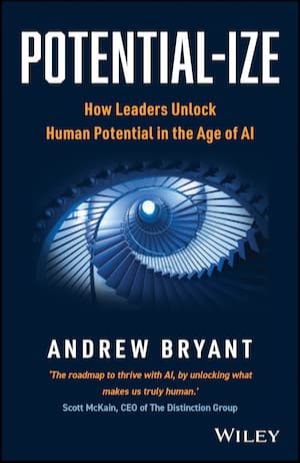
Potential-ize by Andrew Bryant

Potential-ize: How Leaders Unlock Human Potential in the Age of AI.
(Wiley, 2026 ISBN 978-1907312922

In his groundbreaking new book, renowned self-leadership expert Andrew Bryant delivers a roadmap to understanding and unleashing human potential in an age of AI.

Buy the Book →
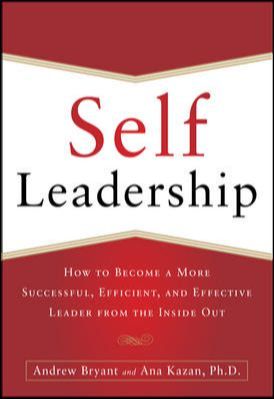
Self Leadership: How to Become a More Successful, Efficient, and Effective Leader from the Inside Out.

Self Leadership: How to Become a More Successful, Efficient, and Effective Leader from the Inside Out.
(McGraw-Hill 2012, ISBN 978 0071799096).

For leaders looking for a plan of ‘Why, What, and How’ to become a better leader, the answer is between the covers of this book.

Buy the Book →
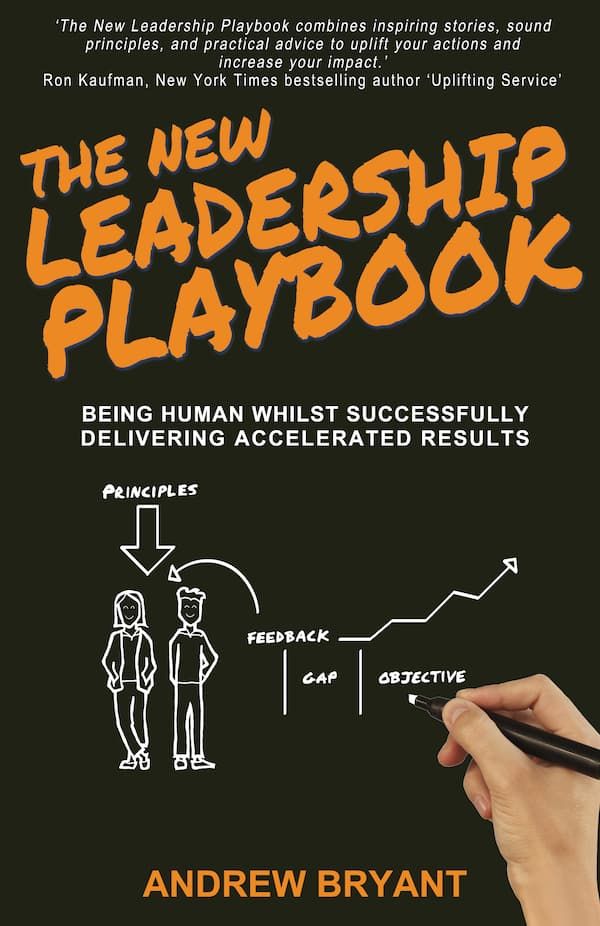
The New Leadership Playbook by Andrew Bryant

The New Leadership Playbook: Being human whilst successfully delivering accelerated results.
(Ocean Reeve 2022, ISBN 978-1922757005)

A practical leadership guide to being human and understanding people, whilst simultaneously driving for accelerated business results.

Free Chapter →
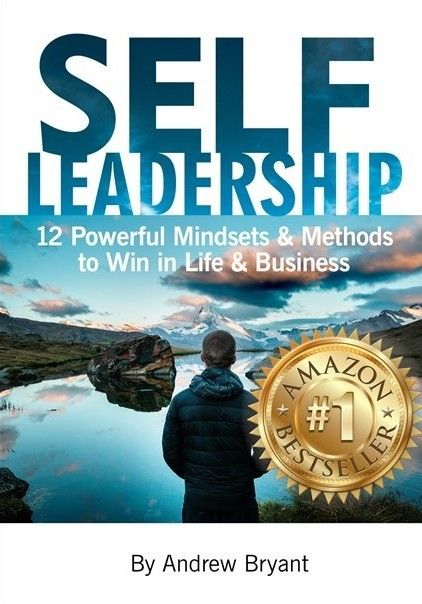
Self leadership 12 Powerful Mindseets Book

Self Leadership: 12 Powerful Mindsets & Methods to Win in Life & Business.
(SLI 2017, 978-9810994013)

Explore your Self-awareness, expand your Self-Confidence, build your Self-Efficacy, whilst you learn to set your intention for greater influence and impact.

Buy the Book →

Back to the top → 

What does the research say about self-leadership?

Become Certified in Self-leadership →

While Manz, Neck, and Houghton built the theoretical and measurement foundations of self-leadership, Bryant translated that research into a practical development methodology - one that works in leadership offsite programs and executive coaching, not just in academic journals.

What distinguishes the Bryant & Kazan approach is that it moved beyond strategy taxonomy to a competency architecture. Strategies are what you do. Competencies are what you become capable of doing well. Development is the bridge between the two.

For the full history of how this model developed, and the research citing it, see the
Self-Leadership Research Hub →

Selected Research Evidence for Self-Leadership

Research Finding Source What It Supports
Self-leadership and related development approaches have been studied as ways of strengthening leadership capacities, including self-awareness, resilience and performance. Tenschert, Furtner & Peters Evidence that self-leadership can play a meaningful role in leadership development, while also highlighting the need for rigorous and context-sensitive research.
Self-leadership has been examined as a factor in the relationship between entrepreneurial orientation and innovative work behaviour. Kör (2016) Self-leadership as a mechanism that may support innovation, initiative and entrepreneurial behaviour in organizations.
Self-leadership demonstrates evidence of cross-cultural validity, including measurement invariance across four national cultures. Houghton, Carnes & Ellison (2014) Evidence that self-leadership can be meaningfully studied across different cultural contexts rather than being limited to one national or organizational setting.
Want to explore the evidence in more depth?
See meta-analyses, systematic reviews, key peer-reviewed studies, institutional references and the full bibliography of research citing Bryant & Kazan on the Self-Leadership Research Hub →

References

  1. Manz, C. C., & Sims, H. P., Jr. (1980). Self-management as a substitute for leadership: A social learning theory perspective. Academy of Management Review, 5(3), 361-367. doi:10.5465/amr.1980.4288845
  2. Manz, C. C. (1983). The Art of Self-Leadership: Strategies for Personal Effectiveness in Your Life and Work. Englewood Cliffs, NJ: Prentice-Hall.
  3. Manz, C. C. (1986). Self-leadership: Toward an expanded theory of self-influence processes in organizations. Academy of Management Review, 11(3), 585-600. doi:10.5465/amr.1986.4306232
  4. Houghton, J. D., & Neck, C. P. (2002). The revised self-leadership questionnaire: Testing a hierarchical factor structure for self-leadership. Journal of Managerial Psychology, 17(8), 672-691. doi:10.1108/02683940210450484
  5. Neck, C. P., & Houghton, J. D. (2006). Two decades of self-leadership theory and research: Past developments, present trends, and future possibilities. Journal of Managerial Psychology, 21(4), 270-295. doi:10.1108/02683940610663097
  6. Bryant, A., & Kazan, A. L. (2012). Self-Leadership: How to Become a More Successful, Efficient, and Effective Leader from the Inside Out. New York: McGraw-Hill.
  7. Neck, C. P., & Manz, C. C. (2013). Mastering Self-Leadership: Empowering Yourself for Personal Excellence (6th ed.). Upper Saddle River, NJ: Pearson.
  8. Neck, C. P., Manz, C. C., & Houghton, J. D. (2019). Self-Leadership: The Definitive Guide to Personal Excellence (2nd ed.). Thousand Oaks, CA: SAGE Publications.
  9. Goldsby, M. G., Goldsby, E. A., Neck, C. B., Neck, C. P., & Mathews, R. (2021). Self-leadership: A four decade review of the literature and trainings. Administrative Sciences, 11(1), 25. doi:10.3390/admsci11010025
  10. Krampitz, J., Seubert, C., Furtner, M., & Glaser, J. (2021). Self-leadership: A meta-analytic review of intervention effects on leaders' capacities. Journal of Leadership Studies, 15(3), 21-39. doi:10.1002/jls.21782
  11. Vargas, R. J., Santos, O., Fialho, M., Costa, J., Eifler, N., Marques-Quinteiro, P., & Curral, L. (2025). Lead yourself to the zone and be happy: The effect of self-leadership development on flow and happiness. PLOS ONE, 20(9), e0331673. doi:10.1371/journal.pone.0331673

Self Leadership or Self-Leadership: Which Spelling Is Correct?

Self leadership and self-leadership are the same practice, spelled two different ways. There is no difference in meaning between them.

  • Self leadership (no hyphen): the spelling Andrew Bryant used in the title of his book, Self Leadership (McGraw-Hill, 2012). He now uses the hyphenated spelling.
  • Self-leadership (hyphenated): the spelling most common in academic literature, in the tradition of Manz, Neck, and Houghton.

The definition doesn't change with the spelling: intentionally influencing your own thinking, feelings, and actions toward your objectives.

FAQs About Self-Leadership

Want to bring this to your organization?

Andrew Bryant is the only keynote speaker who has spent 25 years building the academic foundation of self-leadership and delivering it from the stage in 40+ countries.

If your conference or leadership team needs the real thing, not a summary of it, that is what he delivers.

Andrew Bryant Leadership Speaker →
Self-leadership Coaching →

International Locations

[London]  [Lisbon]  [Stockholm]  [Madrid]  [Barcelona]  [Dubai]  [Singapore]  [Sydney]